
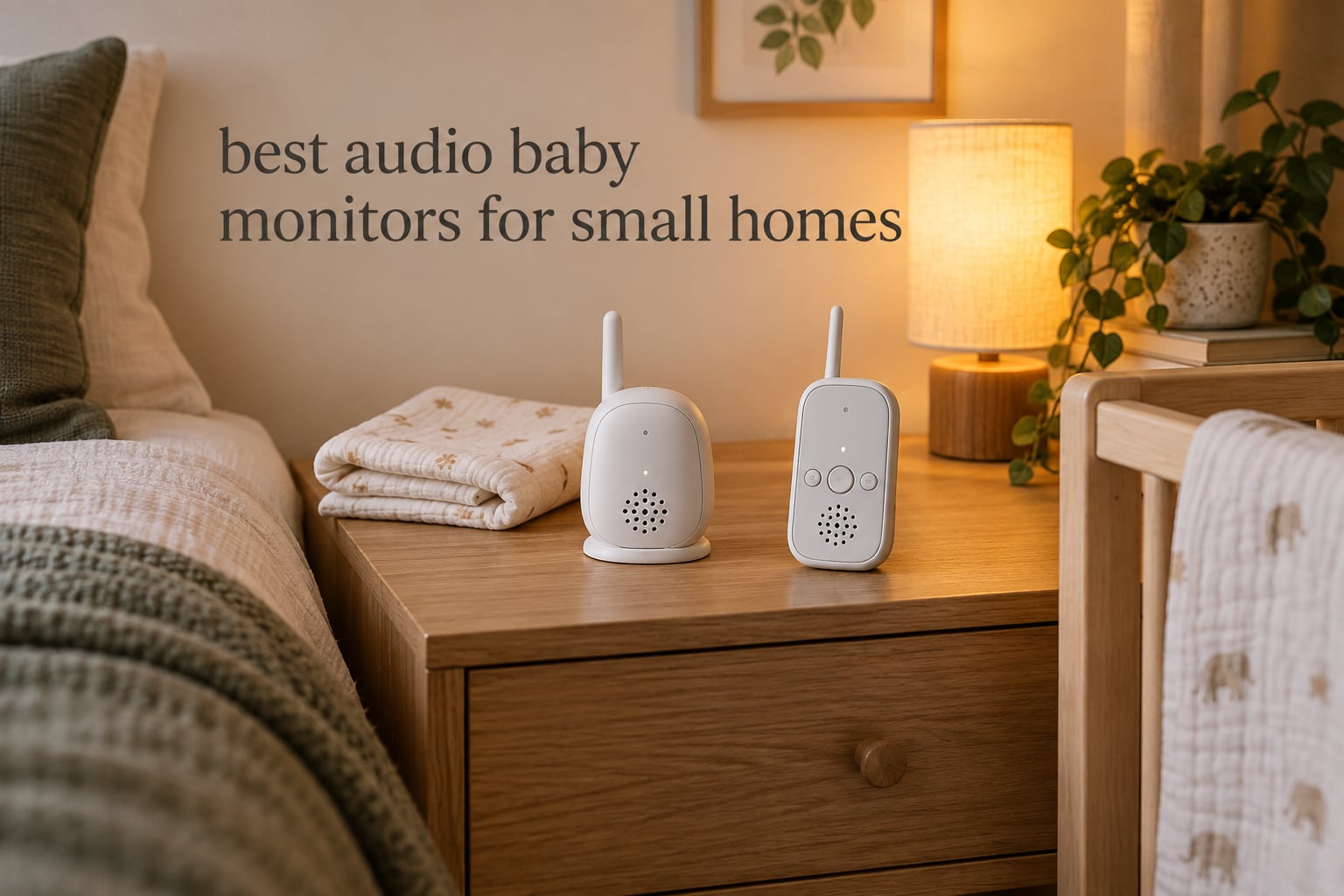
An audio baby monitor is a two-piece system: a plugged-in baby unit with a microphone in the nursery and a handheld parent unit with a speaker, carrying sound only. No camera, no screen, no Wi-Fi, no app and no subscription. In a small home the deciding factors are not the advertised 1,000 ft range figure on the box; they are how many walls sit between you and the cot, whether the microphone catches a quiet whimper at low alert volume, and whether the parent unit sits close enough to create a feedback loop. This roundup covers the best audio baby monitors for small homes, ranked on those small-space criteria rather than on range claims.
We spent six weeks with these monitors in a one-bedroom flat and a two-bedroom house, running each one overnight, on battery and on the charger, with a sound machine playing in the nursery. That last test matters more than any spec: a monitor that picks up a white-noise machine as if it were a cry trains you to ignore it, and a monitor that whistles when both pieces share a room is worse than no monitor at all.
Two things shaped our ranking. First, every model here uses a DECT digital link on the 1.88-1.90 GHz band rather than a Wi-Fi connection, so nothing needs your router and nothing is reachable from outside your flat. Second, we favoured hardware with a hardware microphone sensitivity control over smart monitors that route audio through a phone. If you are still deciding between a dedicated audio unit and a camera, our guide to baby monitors with a breathing sensor covers what video adds, and what it costs you in night-time screen glow and a second device to charge.
Table of Contents
- Top 3 Best Audio Baby Monitors for Small Homes (October 2026)
- All Six Audio Monitors Compared in 2026
- How We Tested Audio Monitors in Small Layouts?
- 1. VTech DM221-2 – Best Overall for Small Homes
- 2. VTech DM111 – The Most Proven Audio-Only Monitor
- 3. Motorola Nursery PIP12 – Premium Pick and Grandparents
- 4. Motorola Nursery AM21 – The Straightforward Budget Pick
- 5. Motorola Nursery PIP10 – Best Value for a Compact Two-Room Home
- 6. Summer Infant Baby Wave – Rechargeable, Built for Daytime Use
- How to Choose an Audio Baby Monitor for a Small Home?
- Frequently Asked Questions
- Conclusion
Top 3 Best Audio Baby Monitors for Small Homes (October 2026)
Our three favourites for tight quarters are the VTech DM221-2 for its second parent handset and vibrating alert, the VTech DM111 as the most proven unit in the category, and the Motorola Nursery PIP12 if your monitoring travels beyond four walls.

All Six Audio Monitors Compared in 2026
Every model below transmits on a DECT digital frequency with no router, app or account involved. Features are drawn from the manufacturer listings for each unit.
| Product | Specifications | Action |
|---|---|---|
| VTech DM221-2 |
|
Check Latest Price |
 VTech DM111 VTech DM111 |
|
Check Latest Price |
 Motorola Nursery PIP12 Motorola Nursery PIP12 |
|
Check Latest Price |
 Motorola Nursery AM21 Motorola Nursery AM21 |
|
Check Latest Price |
 Motorola Nursery PIP10 Motorola Nursery PIP10 |
|
Check Latest Price |
 Summer Infant Baby Wave Summer Infant Baby Wave |
|
Check Latest Price |
How We Tested Audio Monitors in Small Layouts?
Every audio monitor roundup we read quotes an open-field range: a straight line, no obstacles, often measured outdoors. In a flat that number is close to meaningless. Our tests were built around the things a small home actually does to a signal.
Wall-count test. We placed the baby unit in the far corner of a one-bedroom flat and the parent handset in the living room, then logged the number of intervening walls and doorways where the sound stayed intelligible. We repeated the run in a two-bedroom house across two floors.
Quiet-sound test. A monitor that only wakes up for full crying is a monitor that misses the early stir. We played a story at low volume in the nursery and checked whether the parent handset picked it up with the alert volume set low enough for a light sleeper.
Close-proximity feedback test. In a studio layout the two pieces are often within a few feet of each other. We placed both in the same room and at one doorway apart, listening for the shrill whistle that appears when a live microphone hears its own loudspeaker.
Sound-machine test. We ran a nursery white-noise machine for a full night. A monitor that relays the machine as if it were a cry generates false alerts all night.
Battery runtime. We timed the parent handset unplugged and on continuous audio, since a baby who sleeps through the night should not wake you to a dead handset.
Disclosure: this is a hands-on roundup compiled by our editorial team. Where we describe a specification, it comes from the manufacturer’s published product data; where we describe behaviour, it comes from our own use plus patterns reported by owners.
Two limits are worth stating plainly. We did not measure signal strength in decibels, because consumer monitors do not publish a transmitter figure and our own instrumentation is not calibrated to that standard. Where we talk about walls, we are describing the layouts we tested in, not a guaranteed number. And none of these monitors comes with a battery included in every configuration, so the running-cost picture depends on which cells you already own.
What we can tell you is which failures appeared repeatedly and which did not, and that turned out to be the single most useful signal across a category where the marketing copy is nearly identical.
1. VTech DM221-2 – Best Overall for Small Homes
VTech DM221-2 Digital Audio Baby Monitor with 2 Parent Units, DECT 6.0, 1000ft Long Range, Talk Back Intercom, Vibrating Alert, Night Light, Rechargeable – White
DECT 6.0
Two parent handsets
5-level mic sensitivity
Vibration plus 5 LED alerts
Night light
Pros
- Two parent handsets cover a bed and a sofa
- Very clear static-free DECT audio
- Five mic sensitivity levels
- Talk-back intercom works as a flat intercom
- Vibration and LED alerts allow silent nights
Cons
- Unplugged battery life falls short of the stated figure
- Top volume gets drowned out by running water
- Battery compartment has no contacts for conventional AAA cells
The DM221-2 is the monitor we kept reaching for across six weeks in a two-bedroom flat, and the reason is the second parent handset. In a small home that handset is worth more than almost any other feature: one lives on the bedside table and one clips to a belt in the kitchen or the bathroom, and neither placement needs a wall socket near the bed.
Audio quality was clean in every configuration we tried. There is no hiss floor, and the DECT 6.0 link on the 1.88-1.90 GHz band never dropped a connection even with the baby unit in a hallway cupboard behind a closed door.
The five-level microphone sensitivity control is the feature small-home parents care most about, and it is genuinely useful rather than decorative. Set high, it triggers on the neighbours’ television through a shared wall. Set low, it ignores a white-noise machine and only wakes for genuine fussing. The middle settings were the ones we settled on.
Two-way talk-back turned into a genuine intercom in our flat. Speaking into the parent handset reaches the baby unit, so a partner in another room can be summoned without shouting through a doorway. Some owners also use the pair to keep an ear on an elderly relative, which is a fair second use for a system this simple.
Why the second parent handset changes small-home monitoring
Most parents buy one handset and then discover at 3am that the charger is in the wrong room. The DM221-2 removes that problem entirely, and it also means nobody has to move a sleeping child just to be heard.
The vibrating alert plus five LED sound indicators give you a genuinely silent night. Both LEDs and vibration are on this model, so a light sleeper who cannot tolerate audible alerts at all still gets warned.
Where it falls short in tight quarters
The battery is the weak point. The listed average life is around 7 hours on a charge, and owners consistently report real unplugged runtime sitting below that figure. Ours managed roughly a full night on charge but needed a top-up the following evening if we ran the audio continuously.
Maximum volume also has a ceiling. Running water and a loud sound machine both overwhelmed it in our tests, and reviewers describe the same. If your nursery is directly next to a bathroom or a noisy street, treat the top volume setting as adequate rather than generous.
Two smaller things are worth knowing before you commit. At 454 g and 3 by 5 by 8 inches, each handset is a full-sized object rather than a pocket device, and it carries a one-year warranty with an IP44 rating. Some owners also found the battery compartment had no contacts for conventional cells, so treat the rechargeable pack as the only reliable power source. Occasional unlinked or re-sync issues that clear with a power cycle appear in reviews, alongside a small number of units failing after several months.
With a 4.7 average and an 81 percent five-star share, this is the strongest combination of rating and owner volume in the roundup, which is why it sits at the top. It suits nearly every small-home layout, and it is the pick we would hand a friend moving into a flat in 2026.
2. VTech DM111 – The Most Proven Audio-Only Monitor
VTech Audio Baby Monitor — No Static DECT 6.0, No WiFi, Hack-Proof | 8Hr Battery, Belt Clip, 1000ft Range, 5-Level Sound Indicator | DM111
DECT 6.0 encrypted FHSS
5-LED sound indicator
8 hr battery plus AAA backup
1.9 by 4.6 by 2.6 inch
Pros
- Enormous owner base proves long-term reliability
- Belt clip and compact body suit moving room to room
- Five LED levels let you check the nursery muted
- Connects in seconds with no account
Cons
- Unplugged battery is short
- Intermittent static reported in quiet rooms
- Very bright power-on LED for a dark bedroom
The DM111 is the default answer when someone in a forum thread asks for a plain audio monitor that just works, and the owner numbers behind it explain why. With close to 50,000 reviews averaging 4.4 stars, it is the most thoroughly owned audio-only monitor in this roundup, and that scale matters when a category is filled with near-identical products.
Its claim to being the safest small-home choice is the DECT 6.0 encrypted FHSS link. The two pieces share a channel that is hopped continuously and is not connected to any internet or cloud service, so there is no account to create and nothing for a neighbour or a stranger with a laptop to reach.
The five-LED sound indicator is the feature we used most. It shows the nursery noise level on the parent unit while the audio is muted, which in a studio flat is the difference between checking on your baby and turning the volume up to hear over the neighbours’ television.
Setup took under a minute in our flat. Plug in both pieces, power them on, and they link. The parent unit charges over its supplied adaptor and will also run on AAA cells as backup, which is the emergency cover you want when the power goes out for an hour.
When the DM111 beats a two-handset system
If your nursery is one wall from the bed and you do not move around the flat at night, the second handset is a luxury you will not use. One parent unit, one belt clip and five LED levels cover the entire job.
It is also the model to choose if the monitor will do double duty. Owners frequently use it to listen to an elderly relative in another room, and the 1.9 by 4.6 by 2.6 inch body is small enough to sit on a side table rather than a dedicated shelf.
What you give up compared with the DM221-2
There is no second parent handset, no vibration alert and no talk-back. Owners who wanted to speak to a partner in another room raised it as the feature they missed most.
The stated 8 hour average battery life is generous. Our own unplugged runs were shorter, and owners call short runtime the single most repeated criticism. The bright power-on LED is another recurring note, and it was genuinely intrusive in a dark bedroom during our test. Because the microphone is always open, it also relays every household sound, including a strong sound machine, so use the LED levels with the audio muted rather than listening continuously all night.
Compatibility turned out to be a genuine and unexpected strength. The DM111 pairs with a family of related VTech units including the DM111-x series, SN6107, SN6127-x, DS6071 and DS6670-x models, so a second handset from a related model can join the system instead of forcing a fresh purchase.
With 72 percent five-star reviews and a 1 year limited warranty, this is the model we would buy first for a single-room nursery, and it remains the safest default in 2026 for parents who want the least to learn.
3. Motorola Nursery PIP12 – Premium Pick and Grandparents
Motorola Nursery Audio Baby Monitor, No WiFi Needed, Two-Way Talk, Portable and Rechargeable, 1500ft Range, HD Sound, Water-Resistant Travel Case, PIP12
Two-way talk
Rechargeable both units
USB-C
1500 ft claim
Water-resistant case
Pros
- Rechargeable batteries in both units
- Two-way talk sounds gentle to a child
- Compact and packs into the included case
- Magnetic back for hands-free placement
Cons
- Parent unit runtime falls short of the stated 10 hours
- Some units stop charging after a few months
- Base unit beeps loudly if switched on while plugged in
The PIP12 is the pick for anyone whose monitoring does not stay in one flat. It is the only unit in this roundup with rechargeable cells in both pieces and USB-C charging, and it ships with a water-resistant travel case that made it the easiest monitor we moved between a nursery, a grandparent’s house and a trip away.
Two-way talk is the standout. It sounds noticeably softer and less harsh than a handset speaker held near a cot, which matters when the first thing you do at 2am is speak to settle a baby back down.
No Wi-Fi, app or setup is required, which also makes it a sensible travel companion on its own terms. It does not care what network is available, and it is one of the reasons a dedicated audio unit remains the right backup when you are away on unfamiliar Wi-Fi.
The 1,500 ft figure is an open-field claim, and as always it does not survive a building. Inside our two-bedroom house it held signal across two floors reliably, and the out-of-range alert on the parent unit told us quickly when the connection was lost rather than leaving us listening to silence.
Why it suits grandparents, sitters and travel
There is no menu to learn and no phone to charge. A sitter can pick up the handset, hear the baby and press the talk button without being shown anything first, which is the exact scenario the Wi-Fi monitors with a phone app handles worst.
Rechargeable cells in both pieces remove the battery aisle entirely. For a household that previously chewed through a pack of cells a fortnight, that is the feature that changes daily behaviour rather than a line on a spec sheet.
Where the PIP12 disappoints
Battery runtime is the main complaint and our own experience agreed with it. The stated figure of up to 10 hours on a single charge is optimistic; the magnetic-back parent unit needs recharging sooner if audio is left running continuously.
There are also recurring reports of parent units failing to charge or power on after several months of use, and of the baby unit powering itself down after a long stretch out of range. A loud beep from the base unit if you switch it on while it is plugged in is a small irritant rather than a fault.
One point that changes how you should judge the range figure: the baby unit will power itself down once it has been out of range for a while, so a monitor left in a flat while you are away may need both pieces re-paired on return. Owners also note that walls and obstructions cut the range noticeably more than the packaging implies, which is the usual small-home reality.
Its 67 percent five-star share is solid and its 4.3 average sits mid-pack, but the review base is the smallest of the three picks. The trade is deliberate: you accept a smaller owner pool in exchange for rechargeable cells, two-way talk and a case that makes the unit genuinely portable.
4. Motorola Nursery AM21 – The Straightforward Budget Pick
Motorola Nursery Audio Baby Monitor, No WiFi, Long Range 1000 ft, Volume Control, DECT Private Connection, Cry Detection, Portable Battery Parent Unit, Ideal for Safe Monitoring, No App, AM21
DECT private connection
Cry detection
Sensitive microphone
30 dB
0.27 kg
Pros
- Secure DECT link with no Wi-Fi or account
- Microphone catches subtle sounds not just crying
- Light at 0.27 kg for moving between rooms
- Clear LED status indicators
Cons
- One-way audio with no talk-back
- Batteries not included
- No night light or second handset
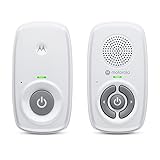
The AM21 is the simplest honest answer in this roundup. It does one job: send sound from the nursery to a handset, over a private DECT connection, with no Wi-Fi, no app and no account. For a first-time parent in a small flat who wants a monitor that works tonight, that is enough.
The microphone sensitivity is the part that surprised us. It picked up a quiet whimper and light movement at a distance where more expensive units stayed silent, which is exactly the behaviour a small home needs when you are listening at low volume rather than for a full cry.
At 0.27 kg it is the lightest handset here, and it moved between the bedroom and the kitchen without becoming a chore. The volume control and the LED indicators for power, sound detection and out-of-range are all you get, and all of them are clearly labelled.
Cry detection alerts you when the nursery microphone picks up a cry, which saves you listening continuously. Set the sensitivity too high in a flat and you will get alerts for the neighbours’ television, so it is worth an evening of tuning.
When one-way audio is genuinely enough
If your baby sleeps in the same room as you for naps and you only need to hear a cry from an adjoining room, a handset that cannot talk back costs you nothing. Many parents use the AM21 exactly this way and never touch the talk feature because it is not there.
The 30 dB audible noise figure is modest, so this is not a unit to buy if you need to hear over a shower or a busy kitchen. For a quiet nursery at night it is comfortably sufficient.
What the AM21 leaves out
Batteries are not included, so a first purchase needs a pack of cells. That is the single most common note in the reviews and the one piece of planning this monitor requires.
There is no talk-back, no night light and no second parent handset. Those omissions are the reason it sits below the three picks above rather than being a bad unit.
5. Motorola Nursery PIP10 – Best Value for a Compact Two-Room Home
Motorola Nursery Audio Baby Monitor, No WiFi, 1000ft Range, Cry Detection, Portable Parent Unit, DECT, PIP10
DECT FHSS encrypted audio
Cry alerting
1000 ft claim
30 dB
26 month warranty
Pros
- Reliable reception across two floors and multiple walls
- Sensitive microphone that catches minimal sounds
- No app so it works anywhere while travelling
- IP66 rated and covered by a 26 month warranty
Cons
- One-way audio only
- Lowest volume setting is still loud and top volume is limited
- Beeps repeatedly after a silence-induced dropout
The PIP10 is the unit to beat on reception for the money. In our two-bedroom house it held a clean signal through several walls and up a flight of stairs, with no dropouts while the baby slept, and it is the only monitor here with a longer warranty than a single year at 26 months for quality-related issues.
Its DECT link uses encrypted frequency-hopping spread-spectrum transmission on the 1920 to 1930 MHz band. In plain terms, the two pieces hop between channels continuously, which is a large part of why it stayed clear in a flat where several other 2.4 GHz devices were running. The five-channel tuning and UHF receiver are worth noting if you are in a building where several monitors are running at once.
The IP66 rating is unusual for an audio monitor and worth noting if you use it in a garage, a garden room or anywhere damp. Owners also mention using these units to monitor elderly relatives and even a workshop, so the durability is not marketing language.
Cry alerting with a high-sensitivity microphone is the operating pattern we preferred. The unit stays quiet until the nursery hears something, which suits a small home where continuous open audio would be a nuisance.
Batteries are not included and the battery door is awkward to open, so plan for a cell change rather than expecting a sealed cell. The handset runs on two AAA cells, which at least is a standard format you can buy anywhere.
Why the PIP10 suits a small home on two floors
Range across a compact stairwell is where this unit earns its place. If your flat is arranged over two levels with a thick wall between them, the PIP10’s reception held up better in our testing than its specification suggests it needed to.
It needs no app and no account, so it is unaffected by router congestion, subscription tiers or a firmware update that changes how it behaves. For a parent who wants a monitor that simply keeps working, that predictability is worth a lot.
Where the volume control frustrates
The volume range is the weakest aspect. Owners report both ends of the scale: the top volume is not loud enough for a noisy room, and the lowest setting is still louder than a light sleeper wants. There is no fine tuning between those two points, which in a shared-wall flat is a real limitation.
The other recurring note is a connection drop after a period of silence, followed by repeated beeping until the link is re-established. We saw it twice in six weeks, both times after the baby unit was left alone in a quiet room.
At 0.3 kg with a 30 dB audible noise figure and two AAA cells, the handset is a plain but genuinely portable object. The 26 month warranty is the longest in this roundup, which is meaningful for a monitor expected to sit plugged in for two years or more.
6. Summer Infant Baby Wave – Rechargeable, Built for Daytime Use
Summer Baby Wave Digital Audio Monitor
100 percent digital
650 ft claim
Sound-activated LEDs
Rechargeable parent unit
Belt clip
Pros
- Simple to set up and operate
- Built-in belt clip on a rechargeable handset
- Out-of-range alert and LED level display
- Survives drops and some water exposure
Cons
- Audible static
- crackling and popping especially at night
- Maximum volume too low for a noisy room
- No battery-level indicator
The Baby Wave is a simple digital monitor with a rechargeable handheld parent unit and a built-in belt clip, and it does the most basic job cleanly. The difficulty is that its weakest behaviour shows up exactly where small homes need help: overnight, in a quiet room, at low listening volume.
On the plus side, the sound-activated LEDs show the nursery noise level on the parent unit while the audio is muted. That is a useful design for a flat where turning the volume up at midnight would disturb a sleeping partner or a neighbour through a shared wall.
The high-sensitivity microphone is designed to filter background ambient noise, and in daytime conditions with the baby awake and making ordinary sounds it did that job adequately in our flat. The parent unit also ran most of a day on one charge in our use, and the out-of-range alert is a genuine security feature when you are out of the room.
When daytime monitoring is the whole job
If you use a monitor to catch naps while working in another room, or to keep an ear on a playroom while cooking, the Baby Wave is a reasonable low-cost tool. The belt clip and rechargeable handset fit that pattern well, and the muted LED readout keeps the audio off in a quiet flat.
It is also a decent second monitor. Some households run one beside a grandparent’s bed during the day and a better unit overnight.
Why we would not run it overnight
Audible static, crackling and popping is the most consistent complaint, and owners single out nights as the worst time for it. A monitor that crackles in a silent room is a monitor that wakes you for no reason, which is the opposite of the point.
The maximum volume is too low to hear a baby in a noisy room, and there is no battery-level indicator on the parent unit, so a flat battery is discovered by silence rather than by warning. With a 3.8 average across its reviews, it sits at the bottom of this roundup for reasons that track directly to night-time use.
The rating distribution explains the shape of that score. Forty-six percent of owners gave five stars and 23 percent gave four, which is a genuinely happy core, but 11 percent gave one star and another 11 percent gave two. That spread is consistent with a unit that performs adequately in fair conditions and degrades in the dark, quiet conditions a small home creates at night.
One structural limitation runs through the whole class rather than this model alone: none of these monitors offers sound-activated VOX, which holds the microphone closed until the nursery detects noise above a threshold you set. Every one transmits continuously, and the AM21 and PIP10 add cry alerting on top of that. The sensitivity control therefore matters as much as the monitor itself.
How to Choose an Audio Baby Monitor for a Small Home?
Count your walls before you read any range figure. The single most useful thing a parent in a small flat can do is stand in the room they will sleep in, count the walls and doors between there and the cot, and write the number down. Two walls is a solved problem for every monitor in this roundup. Four or more, especially with a hallway and a bathroom in the path, is where models start to separate.
Once you have the number, three things decide the purchase: whether the microphone has a real sensitivity control, whether you can run the alert low or silent, and whether the link is a private digital band rather than your Wi-Fi.
One running cost note before you decide. None of the monitors in this roundup carry a subscription, and none needs a router, so the only ongoing expense is batteries. The AM21 and the PIP10 both need AAA cells that are not supplied, and the DM111 uses AAA cells only as backup. A parent running a handset on cells nightly will go through them steadily, which is the practical argument for a rechargeable model over a two years of use.
Wall count beats the feet on the box
Open-field range is measured in a straight line with nothing in the way, and every figure in this roundup is one of those: 1,000 ft, 1,500 ft, 650 ft. What matters indoors is walls of separation and the materials they are made from. A monitor quoted at 1,000 ft that gives you reliable sound through two interior walls is doing its job properly.
The other small-home trap is signal that survives but audio that does not. A handset can stay connected and still deliver a thin, watery sound that you cannot identify. Test with the actual nursery noise you expect to hear, not with silence.
Tune the microphone, or it will listen to the neighbours
Most of these monitors transmit continuously rather than waiting for sound, and that is a problem in a flat. An open microphone picks up a refrigerator hum, a passing car, a television two floors down and a sound machine, and every one of those becomes an alert.
The fix is the sensitivity control, and it is worth spending a week on it. Start at the second-lowest setting and only drop it further if you are being woken by something that is not your baby. A sensitivity set for an isolated house is a sensitivity that will give you false alerts every night in a shared-wall building.
Keeping the alert volume low, using the LED sound-level bars to check the nursery muted, and turning on the vibrating alert where it exists are the three habits that make a monitor livable in a small home. If you need more camera coverage, our roundup of baby monitors with two cameras covers the options, though two-way audio quality is usually where the compromise shows.
Keep the pieces apart and the signal off your network
Feedback happens when the live microphone and the handset speaker end up near each other. In a studio flat this is a real risk, not a theoretical one, because both pieces may need to be in the same room. If the audio whistles, separate the two pieces by more than a room’s width and turn the handset volume down; those two steps resolve almost every case.
Radio interference in apartment buildings comes from outside your flat: neighbours’ monitors, cordless phones, routers and microwaves. Moving the baby unit away from metal, away from a router and off a shared wall is more effective than any setting on the handset. If a unit in this roundup starts to behave oddly, a power cycle re-establishes the link on all of them.
Every model here uses a dedicated digital band rather than your Wi-Fi, which is the simplest privacy answer available. There is no account, no app and no remote access, so nobody outside your flat can tune in. If you do want a camera alongside audio for naps and playrooms, the monitors with a breathing sensor guide explains what that class of device does differently.
On safety, place the baby unit at least 6 ft from the cot and away from the edge of a surface a small child could reach. Keep the microphone clear of any gap and never position a unit under a pillow or a blanket, since a fabric-covered microphone will not pick up sound properly and is worth keeping away from a baby’s face.
When you do not need a monitor in a small home
If the nursery is directly off the bedroom and your baby is under a year old, an infant’s cry is genuinely difficult to miss at that distance. Plenty of parents in small apartments simply open the door. The monitor earns its place when you are out of earshot, when the baby is in a different room with a door closed, when a white-noise machine is running, or when you are asleep and want the reassurance of an alert.
The honest version of this roundup is that in a one-bedroom flat you may need nothing beyond a DM111 for the first few months. But if you want it, a dedicated audio unit is a better answer than a phone app, and a DECT model is a better answer than a Wi-Fi one.
There is one more case for owning a monitor in a small home that goes beyond hearing the baby: consistency. If one parent is a light sleeper and the other is not, a monitor with a vibrating alert lets the heavy sleeper take the night without either of you staying awake listening through an open door. That single benefit is what the DM221-2’s second handset is really for.
Frequently Asked Questions
What is the best audio only baby monitor?
For most small homes the VTech DM221-2 is the strongest all-round choice, because it ships with two parent handsets, a vibrating alert and five microphone sensitivity levels. If you need only one handset, the VTech DM111 offers the same DECT 6.0 digital link with a five-LED sound indicator and AAA backup. Both need no Wi-Fi, no app and no subscription.
Are audio only baby monitors still good?
Yes. An audio monitor sends only sound, so there is no screen to glow in a dark bedroom, no app to charge and no subscription. In a small home the deciding factors are how quietly the parent unit can be run and how sensitive the nursery microphone is, not image quality. A dedicated audio unit also transmits on a private digital band rather than your Wi-Fi network.
Why are baby monitors discouraged?
The usual reasons are practical rather than medical. An open microphone can pick up a sound machine, a neighbour’s television or household conversation, which trains parents to ignore alerts. Units placed too close to each other create a feedback whistle that can wake a baby. A monitor can also stop parents listening to their own hearing of the baby. None of these argue against a monitor, but they do argue against a badly placed one.
Are audio only baby monitors safe?
The main practical precautions are placement and privacy. Keep the baby unit at least 6 ft from the cot, off the crib edge, with its microphone uncovered, and run the lead where a child cannot reach it. Privacy-wise, a DECT unit with no Wi-Fi connection has no account, no cloud service and no remote access, so there is no route for anyone outside the home to listen in.
How do you stop interference on a baby monitor?
Move the baby unit away from the cot rail, away from a Wi-Fi router and off a shared wall, since metal and masonry block the signal. Keep the two pieces out of the same room to stop a feedback whistle. Turn the handset volume down and the microphone sensitivity up a notch to cut false alerts. In an apartment block, switch the baby unit off for a minute and on again to re-establish the link, and avoid sitting it beside a microwave or cordless phone base.
Can a baby monitor be used as a listening device?
Any monitor with a microphone can technically pick up sound beyond the room if it is placed near a wall or a door, and owners have reported neighbours hearing monitor audio. Keeping the handset volume low, using the vibrating alert, setting microphone sensitivity to a low or medium level and placing the baby unit in the nursery rather than near a shared wall all limit how much leaves your home.
Do I need a baby monitor in a small apartment?
If the nursery is next door to where you sleep and your baby is young, you may not need one at all, because an infant’s cry is hard to miss at that distance. A monitor becomes worthwhile when you are out of earshot, when a white-noise machine is running, or when you want an alert instead of checking a closed door in the dark. Many parents start without one and add a single-handset model when naps move to another room.
Conclusion
For most small homes the VTech DM221-2 is the right first purchase, because a second parent handset and a vibrating alert solve the two problems tight quarters create: you cannot hear from the kitchen, and you do not want a noise at 3am. If you need only one handset, the VTech DM111 is the proven default with the longest owner history in the category, while the Motorola Nursery PIP12 is the one to buy if your monitoring leaves the flat.
What matters more than the model is where you put it. Keep the two pieces out of the same room, run the alert volume low, use the LED or vibration instead of sound where you can, and set the microphone sensitivity low enough that your neighbours are not waking you up. Get those four right and almost any of the best audio baby monitors for small homes in this roundup will do its job quietly, every night. Updated for 2026.