
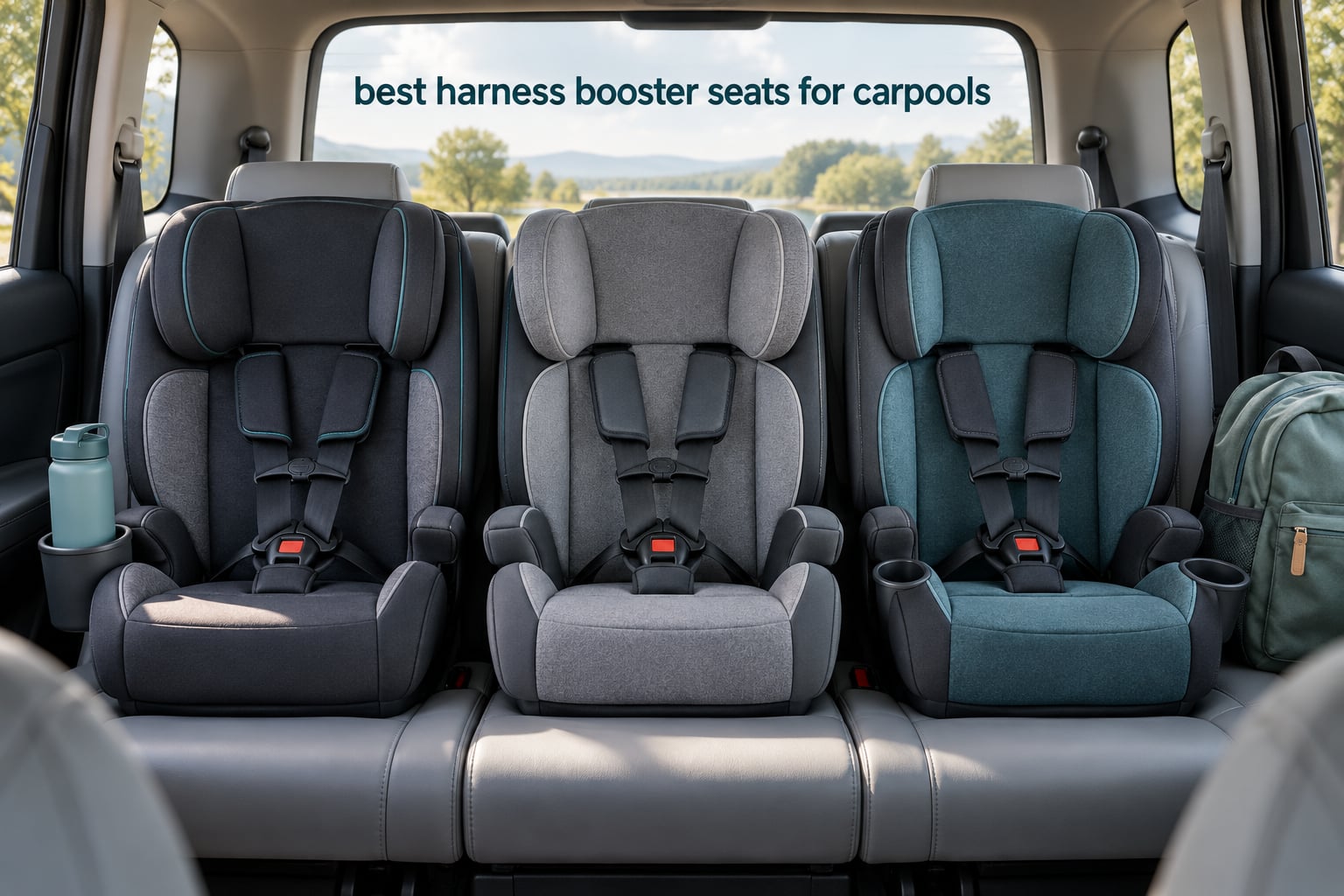
The best harness booster seats for carpools are the Safety 1st Grow and Go, the Graco Extend2Fit, and the Chicco MyFit. All three give a child a 5-point harness that converts to a belt-positioning booster, and all three install with either the vehicle seat belt or lower anchors so one seat can move between two cars. The Grow and Go covers the widest span of stages in this group and carries a 4.7 rating across more than 35k reviews, which is why it takes the top spot. The Extend2Fit is the strongest all-round value for a family that wants rear-facing capability before the harness stage. The MyFit is the one to buy when the second car has tight back seat width or awkward anchor placement.
Carpooling changes the question you should be asking. It is not “which harness booster seat is the safest” but “which harness booster seat can be installed correctly in a car I do not own, by a driver who is not my child’s parent, twice a week without me riding along.” That shifts the weight of the decision onto install flexibility, how the seat is secured when the child is not in it, and whether the seat still fits alongside two other children.
Every seat below is a forward-facing harness seat that later converts to a belt-positioning booster, or a convertible that reaches booster mode after rear-facing and forward-facing stages. I compared the ten published specifications side by side, the install methods each one offers, the reported weight and width where the manufacturer discloses it, and the pattern in more than 118k owner reviews. The carpool verdict at the end of each section is the reason to buy that specific seat, or the reason to skip it.
Table of Contents
- Top 3 Best Harness Booster Seats for Carpools (October 2026)
- The 10 Best Harness Booster Seats for Carpools in 2026
- 1. Safety 1st Grow and Go All-in-One: Best Overall for Carpooling
- 2. Graco Extend2Fit 3-in-1: Best All-Round Value
- 3. KidsEmbrace 2-in-1: Best for Cars With Anchors and No Belt Path
- 4. Chicco MyFit Harness and Booster: Best for Awkward Install Geometry
- 5. Graco SlimFit 3-in-1: Best for Three Across
- 6. Evenflo Maestro Sport: Best for Moving Between Cars Every Day
- 7. Diono Radian 3R: Best for Folding and Storing a Shared Seat
- 8. Britax Grow with You ClickTight: Best for Fast Belt Installs
- 9. Joie Saffron SI 4-in-1: Best Stage Coverage
- 10. Baby Trend Hybrid SI 3-in-1: Best Entry-Level Three-in-One
- Installing a Harness Booster Seat in Someone Else’s Car
- Fitting Three Harness Booster Seats Across the Back Seat
- When to Move From a 5-Point Harness to a Booster?
- How to Choose a Harness Booster Seat for Your Carpool?
- Frequently Asked Questions
- Conclusion
Top 3 Best Harness Booster Seats for Carpools (October 2026)
These are the three I would hand to a carpool driver first, with the reasoning behind each choice.

Safety 1st Grow and Go
- Rear-facing 5-40 lb
- forward-facing 30-65 lb
- booster 40-100 lb
- Seat belt or lower anchors
- QuickFit harness
- Washer-safe pad

Graco Extend2Fit 3-in-1
- Rear-facing 4-50 lb with extension panel
- Forward-facing harness 26.5-65 lb
- Highback booster 40-100 lb
- No-rethread Simply Safe Adjust
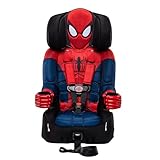
KidsEmbrace 2-in-1 Harness to Booster
- Harness 26.5-65 lb
- Booster 40-100 lb
- Lower anchors plus top tether
- IIHS Best Bet in booster mode
The Grow and Go is the safest default for a carpool seat because it offers both install paths in every stage and does not ask you to choose between them. Seat belt or lower anchors means it works in an older car without anchors and a newer car where the anchor positions are awkward.
The Extend2Fit earns its place for families whose child is still small enough to benefit from rear-facing time. Its four-position extension panel adds up to five inches of legroom, which pushes the rear-facing limit to 50 lb.
The KidsEmbrace is the pick when the receiving car has anchor positions but no usable seat belt path for the child. It installs with lower anchors and a top tether, and it is the only seat in this group with a published IIHS Best Bet rating for the booster mode.
The 10 Best Harness Booster Seats for Carpools in 2026
Every seat in the table converts from a 5-point harness to a belt-positioning booster. The final column is the reason each one earns or loses a place in a two-car week.
| Product | Specifications | Action |
|---|---|---|
| Safety 1st Grow and Go All-in-One |
|
Check Latest Price |
| Graco Extend2Fit 3-in-1 |
|
Check Latest Price |
| KidsEmbrace 2-in-1 Harness and Booster |
|
Check Latest Price |
 Chicco MyFit Harness and Booster Chicco MyFit Harness and Booster |
|
Check Latest Price |
 Graco SlimFit 3-in-1 Graco SlimFit 3-in-1 |
|
Check Latest Price |
 Evenflo Maestro Sport High-Back Evenflo Maestro Sport High-Back |
|
Check Latest Price |
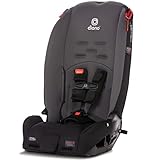 Diono Radian 3R Diono Radian 3R |
|
Check Latest Price |
 Britax Grow with You ClickTight Britax Grow with You ClickTight |
|
Check Latest Price |
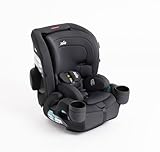 Joie Saffron SI 4-in-1 Joie Saffron SI 4-in-1 |
|
Check Latest Price |
 Baby Trend Hybrid SI 3-in-1 Baby Trend Hybrid SI 3-in-1 |
|
Check Latest Price |
If you want the broad background on seat types rather than carpool specifics, our booster seat roundup covers the belt-positioning seats that come after the harness stage. For the age question that comes up constantly, booster seats for 5 year olds breaks down readiness by maturity rather than by size alone.
1. Safety 1st Grow and Go All-in-One: Best Overall for Carpooling
Safety 1st Grow and Go All-in-One Convertible Car Seat, Black Phantom
Rear-facing 5-40 lb
Forward-facing 30-65 lb
Booster 40-100 lb
Seat belt or lower anchors
Pros
- Covers rear-facing
- forward-facing and booster in one seat
- Seat belt and lower anchor installs both work
- QuickFit harness adjusts in seconds
- Washer-safe snap-off pad with two cup holders
Cons
- Not a slim three-across footprint
- Booster mode is the least refined of the three stages
- Back seat space is noticeably consumed
Three stages in one seat is the core of the Grow and Go, and it is the reason it handles a carpool week without drama. Rear-facing runs 5 to 40 lb up to 40 in, the forward-facing harness covers 30 to 65 lb up to 49 in, and the belt-positioning booster carries 40 to 100 lb up to 52 in. That means a family can hand the same seat to another driver without the receiving family asking whether it is even the right stage for their child.
The detail that matters most for carpools is that both install paths are available in every stage. Vehicle seat belt or lower anchors, with the same hardware either way. In an older car with no anchors, or a car where another child already occupies the anchor positions you need, the belt path still works.
Owner feedback centres on installation and transferability rather than on crash performance language. The QuickFit harness adjuster gets repeated credit for daily in-and-out changes, which matters when the same child rides in two cars on the same day. The snap-off, washer-and-dryer-safe pad is a genuine carpool feature, because breakfast and snack spills are a twice-weekly event, not an occasional one.
Two features are easy to overlook. The removable Grow-With-Me baby pillows help a smaller child sit correctly in the harness, and the three-position recline gives a little more recline angle than a fixed-shell seat. The dual cup holders are dishwasher-safe, which sounds minor until you are wiping granola out of one at 7:40 in the morning.
When this seat causes problems
It is not a slim three-across design, and that is the reason to pass if your carpool puts three children in the back seat. The footprint is substantial, so two Grow and Gos plus a third seat can push the outboard passenger out of position or force the middle child onto the seat belt lap.
Also consider the harness ceiling. The forward-facing harness stops at 65 lb, so a tall child approaching that weight may need a different seat. The booster stage is where this seat is least refined, and reviewers describe the transition as functional rather than polished.
Why carpool drivers accept this one
A seat that installs either way removes the single biggest source of anxiety for a driver who is not the child’s parent, because the installation is not dependent on a specific vehicle feature being present. The other reassurance is stage coverage: the receiving family can see that the same seat serves a 4-year-old in a harness and an 8-year-old in a booster.
Wipe-clean maintenance and a seat that never needs a second purchase during the carpool years are the practical reasons it keeps working as a shared seat. The one thing you must check before handing it over is the expiration date on the label.
2. Graco Extend2Fit 3-in-1: Best All-Round Value
Graco Extend2Fit 3-in-1 Convertible Car Seat, Cullen
Rear-facing 4-50 lb
Forward-facing 26.5-65 lb
Highback booster 40-100 lb
Up to 5 in extra legroom
Pros
- Extension panel extends rear-facing to 50 lb
- No-rethread harness moves headrest and straps together
- ProtectPlus crash testing across frontal side rear and rollover
- Single seat from birth through 100 lb booster
Cons
- Bulkier footprint than slim convertibles
- Extension panel hardware adds weight and rear seat crowding
The Extend2Fit is the one to buy if you want the longest usable life from a single carpool seat. It runs rear-facing from 4 to 50 lb, forward-facing in the harness from 26.5 to 65 lb, and highback booster from 40 to 100 lb. That is a wider usable span than most of the convertibles in this group, and it starts at 4 lb rather than 5.
The four-position extension panel is the feature that changes real life. It adds up to five inches of extra legroom and pushes rear-facing capability to 50 lb, which means a child can stay rear-facing longer. Parents moving up from an infant seat often treat that as the reason the seat is worth having.
The No-Rethread Simply Safe Adjust harness moves the headrest and the harness straps together in one motion. On a shared seat that is used by two adults in two cars, that single-motion adjustment is the difference between a ten-second job and a two-minute job. You do not have to thread straps back through the shell, and you do not have to match strap height to headrest height.
Graco lists ProtectPlus Engineered testing across frontal, side, rear and rollover impacts. It is also the largest review pool we worked with, more than 57k reviews at a 4.8 average, which means the durability feedback covers a real span of years and multiple children per household rather than a few months of use.
When this seat causes problems
It is bulkier than a slim-profile convertible, and the extension panel hardware adds both weight and rear seat crowding. In a carpool where three children share the back seat, this is the second seat most likely to be the one that does not fit three across. Measure before you commit rather than assuming.
The booster stage here is a highback booster only, with no backless mode. If your child will outgrow the harness and still want a backless option later, that transition means a second purchase.
Why carpool drivers accept this one
The install flexibility is the deciding factor. A seat that runs from rear-facing all the way to a 100 lb booster means a carpool can start in the infant years and continue without the family buying anything else. For households with two children close in age, one seat per child covers the whole carpool period.
The single-motion harness adjustment also reduces the chance of a rushed, incorrect install at 7:30 in the morning, which is the moment when most carpool seat errors happen.
3. KidsEmbrace 2-in-1: Best for Cars With Anchors and No Belt Path
KidsEmbrace 2-in-1 Car Seat | Forward-Facing Harness (26.5–65 lbs) & Booster Mode (40–100 lbs) | Latch | Premium Fit with Multi-Position Headrest, Harness & Recline – Marvel Spider-Man
Forward-facing harness 26.5-65 lb (29-49 in)
Belt-positioning booster 40-100 lb (38-57 in)
Lower anchors and top tether
FMVSS 213, IIHS Best Bet in booster mode
Pros
- Only seat here with a published IIHS Best Bet booster rating
- Lower anchors and top tether keep the seat secure
- Character graphics help forward-facing kids accept it
- Dual extra-deep cup holders hold real carpool snacks and drinks
- High-density foam padding
Cons
- No rear-facing mode
- Starts only at 26.5 lb and 29 in
- Wider than narrow three-across convertibles
This is the seat to look at when the receiving car has working lower anchors but a belt path that does not suit the position. It installs with lower anchors and a top tether, which is the combination that keeps a carpool seat anchored in a vehicle you do not control. In a carpool, an unoccupied seat that is properly anchored stays put; one that is only belted may not.
The stage coverage is straightforward. The 5-point harness runs 26.5 to 65 lb between 29 and 49 in, and the belt-positioning booster mode runs 40 to 100 lb up to 57 in. There is no rear-facing stage, so this is a forward-facing purchase once a child outgrows an infant seat.
It meets FMVSS 213 and carries an IIHS Best Bet rating specifically for the belt-positioning booster mode. Best Bet is a separate designation from the federal standard, and it is the only published independent booster rating in this group. That matters most for the later phase of a carpool, when your child is tall and the harness is behind them.
Owners often point to the graphics rather than the specs. A child who has been resisting the move to a forward-facing seat will accept one with a familiar character on it, and in a carpool where children watch each other buckle in, that social pressure is not trivial. The dual extra-deep cup holders are sized for real cups and bottles rather than a small bottle only.
When this seat causes problems
There is no rear-facing mode, so it starts at 26.5 lb and 29 in. If your child is under that, this is the wrong purchase and you need a convertible instead. That is the main scoping limitation and the reason it sits below the two convertibles at the top of the list.
It is also wider than the narrow three-across convertibles. If your carpool puts three children across, verify fit in the receiving vehicle before buying. The warranty is one year limited, which is shorter than some competitors in this group offer.
Why carpool drivers accept this one
The anchor and tether combination is the strongest argument. A driver who is not the parent often worries about what happens to a loose seat in a crash, and a properly anchored seat with a top tether removes that concern in a way a belt-path booster cannot always match.
For a carpool that starts when children are already out of rear-facing seats, the 26.5 lb floor is not a limitation at all. In that case this becomes the safest published booster rating available in the group.
4. Chicco MyFit Harness and Booster: Best for Awkward Install Geometry
Chicco MyFit 2-in-1 Harness + High Back Booster Car Seat
Forward-facing harness 25-65 lb
High back belt-positioning booster to 100 lb
Belt lock-off or LATCH system
25 lb seat, 17.5 in published width
Pros
- Published 17.5 in width suits tight back seats
- Bubble levels and recline leveling built into the seat
- Advanced Side Impact Protection to FMVSS 213a
- 9-position headrest and 4-position recline
- LockSure belt-tightening connectors
Cons
- Forward-facing only with no rear-facing stage
- Starts at 25 lb which is later than infant convertibles
The MyFit is the seat I would pick for a carpool made of small cars. Manufacturer dimensions put it at 20 in deep by 17.5 in wide by 26 in high, and it weighs 25 lb, so it is not the lightest to carry but it is not unwieldy. The width is the number that decides three-across situations, and at 17.5 in it leaves more room than a conventional convertible.
It installs with a belt lock-off or a LATCH system, so the same seat works in a car with anchors and a car without. The forward-facing 5-point harness covers 25 to 65 lb, and the high back belt-positioning booster goes up to 100 lb. There is no rear-facing stage, which keeps the starting weight at 25 lb.
What separates this from other forward-facing harness seats is the install tooling. RideRight bubble levels sit on the seat, and the ReclineSure leveling system handles recline angle, which are the two things a parent installing in a stranger’s car at 7:30 in the morning is most likely to get wrong. LockSure belt-tightening connectors take the guesswork out of the LATCH side too.
Side impact protection here is engineered to FMVSS 213a, the updated side impact standard, and the ErgoBoost seat uses dual-density foam with a 9-position headrest and 4-position recline. The CupFolders fold away completely, which returns width to the seat when nobody is using them.
When this seat causes problems
It is forward-facing only. A family starting from an infant seat needs a convertible, and a child under 25 lb is out of range. The 25 lb floor is later than most infant convertibles in this group, so plan the transition rather than assuming overlap.
At 25 lb the seat is one of the heavier ones in the group, so if your carpool means carrying a seat between two vehicles every morning, check that you can manage it. The trade is width for weight, and the width is the reason to accept that.
Why carpool drivers accept this one
The built-in leveling aids are the reason this is the most forgiving seat to install in an unfamiliar car. Bubble levels remove the most common install error, and they do it without a separate tool, which matters when the driver is someone else entirely.
At 17.5 in wide with folding cup holders, it is the practical choice when a carpool needs three children across. It also sits at 4.8 across more than 5k reviews with a 91 percent five-star share, so the fit and install feedback is consistent rather than anecdotal.
5. Graco SlimFit 3-in-1: Best for Three Across
Graco Slimfit 3-in-1 Convertible Car Seat, Sydney
Rear-facing 5-40 lb
Forward-facing harness 26.5-65 lb
Highback booster 40-100 lb
10 percent slimmer design with rotating cup holders
Pros
- Genuinely fits three across in real vehicles
- Rotating cup holders free up back seat width
- No-rethread harness and headrest move together
- Light enough to carry through an airport
- Owners report repeat success across vehicles
Cons
- Rear openings channel air conditioning onto the child
- Shallow rear-facing recline for small newborns
- Thinner padding than premium seats
The SlimFit exists to solve a specific problem: three children, one back seat. Graco describes it as 10 percent slimmer than its previous generation, and the owner reports back that up. People fitting three across in Mustangs, trucks and compact SUVs describe it as working, and several owners say they own two to four of them.
It covers the full three-stage range. Rear-facing harness 5 to 40 lb, forward-facing harness 26.5 to 65 lb, and highback booster 40 to 100 lb. The 10-position headrest and the No-Rethread Simply Safe Adjust harness move together, so the fit adjustment is one motion even in a cramped back seat.
The dual integrated cup holders rotate away, which is the detail that makes the slim profile work. A cup holder that sticks out sideways is width you do not get back, and in a three-across install every inch of protrusion eats into the neighbouring seat. Light weight is another genuine advantage here, since this is a seat owners carry through airports.
On r/Parenting, parents carpooling with more than one child specifically discuss the Graco 3-in-1 Slim Fit as one of the workable options, noting that the same seat is used through multiple children. That matches what the manufacturer data says about the width, which is why it earns the three-across recommendation.
When this seat causes problems
Openings in the seat back let air conditioning blow directly onto the child’s legs, which owners mention repeatedly in warm climates. The rear-facing recline is also shallow enough that a newborn may need help positioning, so this is not the seat for a baby fresh out of the hospital.
Padding is thinner than premium seats, and it is a highback booster only with no backless mode. At 4.8 with more than 2k reviews it is well rated, but the review base is smaller than the two seats above it, so treat the long-term picture as promising rather than fully settled.
Why carpool drivers accept this one
Width is the whole argument. When a back seat has to hold three children, the seat that makes the geometry possible is the seat that gets bought, and this is the one built for that constraint from the start rather than trimmed down later.
The no-rethread harness and rotating cup holders also reduce the fiddly parts of a shared-seat routine, which is where rushed morning installs go wrong. If your carpool is three across, this is the pick.
6. Evenflo Maestro Sport: Best for Moving Between Cars Every Day
Evenflo High-Back Booster Car Seat with Harness, 22 to 110lbs, Maestro Sport, Granite Gray
Forward-facing harness 30-50 lb
Belt-positioning booster to 100 lb
Vehicle seat belt install
Up-front central harness adjuster
Pros
- Lightest seat to carry between vehicles
- Up-front adjuster tightens the harness without reaching behind
- Simple click-in install in a second car
- Lower seat height helps small children climb in unassisted
- Shoulder belt guide that auto-positions the vehicle belt
Cons
- No lower anchor install reported by owners
- Rigid shell with no flex so it sits straight up
- Thin padding and cup holders that pop out easily
The Maestro Sport is the answer when the carpool means physically moving the seat every day. It is described throughout the reviews as the lightest option in this group, and that single fact changes the whole routine. A seat that can be carried one-handed is installed without planning, where a heavy seat turns every morning into a two-person job.
The two modes are a forward-facing 5-point harness from 30 to 50 lb and a vehicle belt-positioning booster up to 100 lb, with the listed product range given as 22 to 110 lb. Install is by vehicle seat belt, and the shoulder belt guide auto-positions the belt so it lands correctly across the collarbone and hips.
The up-front central harness adjuster tightens the harness from the front of the seat instead of behind it. In a carpool routine this is a real time saver, and it removes the need to reach around a child who is already buckled and squirming. The lower seat height also lets younger children climb in and out without an adult lifting them.
Consolidating the pad, the shoulder belt guide and the dual cup holders, the wipe-clean machine-washable cover is the piece parents notice most. The cup holders hold a cup and a water bottle, which is roughly what a school run needs.
When this seat causes problems
Owners report no lower anchor install path, so this is a seat belt install only. If the receiving car has a belt path that does not work for the position you need, or if the driver’s preference is an anchored seat, this one does not solve that.
The shell is rigid with no flex, so it sits straight up, and padding is thin compared with premium seats. The cup holders pop out easily, which is a recurring complaint. It is also rated below several other seats here at 4.6, with a 77 percent five-star share, and one airline-use review questions crash performance on the basis of how light the seat is.
Why carpool drivers accept this one
Weight is not a minor specification in a two-car week. A light seat is carried, installed and put away without negotiation, which means the install actually gets done properly rather than quickly with a loose belt.
The lower seat height and front-facing adjuster suit a kindergartener learning to buckle in with less help, and the machine-washable pad handles the messes. Choose it for portability and accept the thin padding as the trade.
7. Diono Radian 3R: Best for Folding and Storing a Shared Seat
Diono Radian 3R, 3-in-1 Convertible Car Seat, Rear Facing & Forward Facing, 10 Years 1 Car Seat, Slim Fit 3 Across, Gray Slate
4 modes in 1 seat, 5-120 lb total
Rear-facing up to 50 lb
Automotive-grade steel core shell
Slim fit rated for 3 across
Pros
- Folds flat for storage and airline travel
- Steel-reinforced core shell feels durable
- Low-profile slim design fits three across
- Very low seat height lets siblings climb over it
- Harness straps adjust without constant re-tugging
Cons
- Heavy to move between vehicles
- Complex install with different rules per weight stage
- Center position works rear-facing only
- Extremely deep rear-facing recline moves the front seat
The Radian 3R is the seat for a carpool that is not the only trip. It folds flat, is airline approved, and covers four modes in one seat from 5 to 120 lb, rear-facing up to 50 lb. That combination of folding and full stage coverage is rare among convertibles, and it is why this seat appears in travel-oriented roundups as well as carpool ones.
The shell is a reinforced automotive-grade high-strength steel core, and ComfortPlus memory foam is included. Owners consistently justify the purchase on slim three-across fit, and several run multiple seats across three vehicles, which is a specific carpool use case rather than a general claim.
The low-profile design is the practical win in a shared back seat. A very low seat height means siblings can climb over it to reach their own positions, which matters in a carpool with three children who all need to get out independently. The machine-washable cover removes easily, and harness straps adjust smoothly without constant re-tugging.
There is one install detail worth knowing before a carpool. The center seating position only works rear-facing because of fixed vehicle headrests in many cars, so in forward-facing or booster mode this seat lives in an outboard position. Plan the geometry with that constraint in mind.
When this seat causes problems
It is heavy, and a heavy seat that has to move between two cars every day is a real effort. The installation is also uniquely complex, with multiple modes and different rules per child weight, and a Child Passenger Safety Technician review calls it the most difficult seat they have worked with. That is a genuine warning for a carpool where a different parent installs it.
The rear-facing recline is extremely deep and requires moving the front seat forward, and some owners are uneasy about forward-facing security in this model. If a stranger is installing it twice a week, complexity is the wrong trade.
Why carpool drivers accept this one
The fold-flat design solves a specific problem: where do you keep a second seat that is not in the car? A folding seat lives in a closet or a trunk, and the same feature makes airline travel possible without a separate travel seat.
Steel construction and a low seat height that lets siblings climb over it make it a good fit for three-across families with independent children. It is the pick when folding and durability matter more than a light carry.
8. Britax Grow with You ClickTight: Best for Fast Belt Installs
Britax Grow with You ClickTight Harness-2-Booster Car Seat, Cool N Dry – Cool Flow Moisture Wicking Fabric
Forward-facing harness to belt-positioning booster
ClickTight seat belt install in three steps
Steel frame with crumple zone and SafeCell structure
9-position one-hand headrest
Pros
- ClickTight belt install takes under two minutes
- No lower anchor weight limit to track
- Seat can shift laterally to clear a folding third row
- Stay-put crotch buckle avoids digging under the child
- Cool N Dry wicking fabric for hot climates
Cons
- Heavier than most harness-to-booster seats
- Seat liner clips pop out of place easily
- Narrower headrest range so it starts later
- The two recline angles differ very little
ClickTight is the install method to understand here. The seat is secured with the vehicle seat belt in three steps, open, thread and buckle, close, and the mechanism tightens without the installer leaning into the vehicle to add body weight. For a carpool driver who is not the parent, that removes the most common reason a belt-path install ends up loose.
Because the vehicle belt is what holds the seat, there is no lower anchor weight limit to track. That matters in mixed carpools where one child is large enough to exceed a lower anchor limit and another is not. One owner reports the seat can be shifted laterally to clear a folding third row, which is a geometry trick useful in SUVs.
Side impact protection is two layers, including headrest wings, and the base uses SafeCell energy-absorbing honeycomb structure inside a high-strength steel frame with a crumple zone. The stay-put crotch buckle is designed so the harness does not have to be dug under the child, and the Hugs pads limit strap twisting.
The Cool N Dry moisture-wicking mesh fabric is the detail carpools notice. The cover is washable, the headrest adjusts one-handed across nine positions, and there are two recline angles plus dual cup holders. One owner describes a child walking away from a severe rollover without injury, which is a single report rather than evidence, but it reflects the level of detail owners write about here.
When this seat causes problems
It is heavier than most harness-to-booster seats, which puts it at a disadvantage if the seat moves between cars daily. The seat liner clips also pop out of place easily, and that is the most repeated complaint in the reviews.
The headrest range is narrower than a full three-in-one convertible, so this seat starts later, and the two recline angles differ very little in practice. It is a 4.7 on a smaller review base than the seats above it, so treat the sentiment as strong but not as deep.
Why carpool drivers accept this one
ClickTight solves the exact problem a carpool creates. An install that takes under two minutes and does not need body weight is the difference between a careful install and a hurried one, and it removes any lower anchor weight limit you would otherwise have to check.
The wicking fabric matters in a car that sits in a car park in summer with the engine off, and the lateral shift capability helps when a third row folds. If your carpool car is larger than a compact sedan, this is the pick.
9. Joie Saffron SI 4-in-1: Best Stage Coverage
Joie Saffron SI 4-in-1 Convertible Car Seat to High-Back & Booster
Rear-facing 4-40 lb, forward-facing 30-65 lb
Highback booster 40-110 lb, backless booster 40-120 lb
FMVSS 213a and 213b certified
Approx 23.1 lb, 19 in published width
Pros
- Widest stage range in the set from 4 to 120 lb
- Backless booster mode extends the useful life further
- AutoClick magnetic chest clip is one-handed
- Integrated flip foot gives a deep rear-facing recline
- Plush padding and easy-clean cup holders
Cons
- Smallest review base in the group at 292
- Bulky at 19 in wide next to slim convertibles
The Saffron SI covers four modes: rear-facing harness 4 to 40 lb up to 43 in, forward-facing harness 30 to 65 lb up to 49 in, highback booster 40 to 110 lb up to 57 in, and backless booster 40 to 120 lb up to 60 in. No other seat in this group reaches a backless mode, which means this one can stay with a child until the vehicle belt fits without the vehicle belt being the only thing holding their head up.
It is certified to FMVSS 213a and 213b, which covers both harness and booster configurations. Dimensions are given as 22 in long by 19 in wide, with a height range of 24.5 to 33 in, and the weight is approximately 23.1 lb. That width is the number to check if three children share a back seat.
The AutoClick magnetic chest clip is genuinely useful in a carpool routine because it closes one-handed, without threading a tongue through a buckle behind a child’s back. The 10-position headrest and harness adjust together with one button press, and the one-hand pull converts the seat to backless mode when a child is ready.
Owners mention the higher seating position, which helps toddlers buckle themselves in, and describe the padding as plush with an easy-clean cover. A three-position recline with an integrated flip foot delivers a deep rear-facing recline, useful in a car where the floor is flat rather than sloped.
When this seat causes problems
The review base is 292, the smallest in this group by a wide margin, so the 4.8 rating and 91 percent five-star share describe a promising seat rather than a proven one. Long-term durability data simply does not exist yet at that volume.
At 19 in wide it is bulkier than the slim convertibles here, so it is a harder fit in a three-across arrangement. It is also not the seat to pick if you want the freshest read on how a product ages, because the owner history is thin.
Why carpool drivers accept this one
The backless booster mode is the reason. A highback-only harness seat becomes unusable the day a child outgrows the harness back, and a backless mode extends the seat instead of forcing another purchase mid-carpool.
The magnetic chest clip and single-button headrest adjustment reduce the number of fiddly steps a second adult has to learn, and the flush install is described as straightforward. Buy it for stage coverage, and accept that you are buying a newer design with a shorter review history.
10. Baby Trend Hybrid SI 3-in-1: Best Entry-Level Three-in-One
Baby Trend Hybrid SI 3-in-1 Combination Booster Seat, Hoboken Teal – Side-Impact Protection, 3-Stage Growth Design, Adjustable Headrest, Cushioned Comfort
3-in-1 combination design
5-point harness through belt-positioning booster mode
Adjustable headrest and dual cup holders
Side-impact focused shell
Pros
- Useful as a short-term second carpool seat
- Slim design reported to suit tight vehicles and long-legged children
- Children fall asleep in it on longer trips
- Dual cup holders and cushioned seating
- Simple 3-stage growth design covers harness through booster
Cons
- Instructions reference parts that do not match the product
- Harness runs out of adjustment for a 41 lb child
- Installation routing changes completely between stages
- Back shell pops off during carrying
I want to be straight about this one. The Baby Trend Hybrid SI is a 3-in-1 combination design with a 5-point harness that converts to a belt-positioning booster, an adjustable headrest, dual cup holders, cushioned seating and a side-impact focused shell. The concept fits a carpool budget. The execution is where the problems sit.
It is the lowest rated seat in this group at 4.1, with a 66 percent five-star share and 10 percent one-star. The critical mass of reviews is consistent: the instructions are confusing and reference parts that do not match the product, and the harness runs out of adjustment for a child at the top of its stated range. One owner reports a 41 lb, 41 in four-year-old outgrowing the harness.
The install routing changes completely between the under-40 lb and over-40 lb harness stages, and reviewers describe roughly twelve distinct install paths between modes. In a carpool, where a different adult installs the seat without the manual open on the dashboard, that is a meaningful risk rather than a minor annoyance.
There are real positives. The slim profile suits tight vehicles and long-legged children, children do fall asleep in it on longer trips, and the cushioned seating with dual cup holders covers the practical school-run needs. The 100 percent polyester cover is straightforward to wipe down.
When this seat causes problems
The back shell pops off easily while carrying and is hard to refit, which matters if the seat is transported between cars. Fit also varies sharply by vehicle, with one owner reporting it does not seat properly in a Jeep Wrangler. The padding is thin on longer trips.
The harness adjustment ceiling is the most serious limitation, because it appears at the top of the range the seat is sold for. When your child hits that ceiling mid-carpool you are replacing a seat, not adjusting one.
Why carpool drivers accept this one
The only persuasive argument is the entry point. If the plan is a low-cost seat for a short window, or a second carpool seat that gets handed between two families with minimal fuss, the slim shape and cup holders do the job. A worn cover is a smaller problem than a complicated one.
My recommendation is to treat this as a stopgap and check the harness fit with your child before the first long drive. If you want a shared seat to last, one of the convertible seats above it will cost more attention up front and save the trouble later.
Installing a Harness Booster Seat in Someone Else’s Car
This is the section no competitor roundup covers, and it is the part of carpooling that actually decides whether a shared seat works. A carpool driver who is not your child’s parent has to install your seat correctly, sometimes alone, often in the dark, with three children waiting in the back.
Start by finding out what the receiving car has. Check for lower anchors in the position you need, not just whether the car has them. Many cars have anchors only at the outboard positions, and some have a combined anchor and tether strap rather than separate connectors. If your seat uses dedicated LATCH connectors and the car only has a combination strap, they will not mate.
Next, check the lower anchor weight limit for that position in the vehicle owner’s manual. Several manufacturers cap the combined child weight for a lower anchor install, and the cap is per position, not per car. A carpool with two children over that cap needs at least one seat on a seat belt path.
Then decide the install method deliberately. Do not use the seat belt and the lower anchors at the same time unless the manufacturer explicitly permits it, because most seats treat them as mutually exclusive methods with different routing. Read the seat manual for the exact combination it allows, since this varies by model rather than by category.
For booster mode, the shoulder belt has to land across the collarbone and chest, never the neck, and the lap belt has to sit low across the upper thighs and hip bones. A shoulder belt guide helps, but the guide does not fix an install that is loose. If the belt cannot be tightened, the install is not finished.
When the receiving car is smaller than your own, the install geometry changes. Less legroom means less slack, the seat sits closer to the front seat, and the same seat can require a different recline angle. Bring the manual and expect to redo the install rather than copying what you know.
Finally, a certified child passenger safety technician can check the install in a public setting, and NHTSA maintains a national locator for child passenger safety seat inspection stations. A ten-minute free check is a better use of a carpool week than a month of uncertain installs.
Fitting Three Harness Booster Seats Across the Back Seat
Three across is a geometry problem before it is a safety problem. If the three seats do not physically fit with room for the children, nothing else in this article matters for that carpool, and you will find out at the curb rather than at the shop.
Use published widths where the manufacturer provides them. The Chicco MyFit is listed at 17.5 in wide, and the Joie Saffron SI at 19 in wide. The Graco SlimFit is built 10 percent slimmer than the previous generation and is designed around a three-across fit, and the Diono Radian 3R is rated for three across in a sedan. Those four are the ones to plan a three-across carpool around.
Independent lab testing published by BabyGearLab adds context on the wider market. Their measured widths for comparable harness and booster hardware range from about 15.5 in to 21.5 in, and their heaviest wide model in that booster set, the Britax Grow With You ClickTight+, measured 21.5 in across. If your carpool needs three seats across, budget for widths in that range rather than assuming every harness seat is the same size.
Cup holders count too. A seat with fixed cup holders on the side is width you cannot get back. The Graco SlimFit rotates its dual cup holders away, and the Chicco MyFit folds its CupFolders completely flat, which is why both are more three-across friendly than their raw widths alone suggest.
Seat height matters for the children, not just for the fit. A very low seat means siblings can climb over it to reach their own positions, which is why the Diono Radian 3R gets regular credit in three-across carpools. The Evenflo Maestro Sport is the opposite, a low seat height that helps small children climb in unassisted.
One practical rule: measure the usable back seat width in the receiving car with the front seats where they will actually be, then compare it against the sum of the three published widths. If the sum exceeds the space, the middle child will be sitting on a lap belt, which is not an option.
When to Move From a 5-Point Harness to a Booster?
The 5-point harness is the most restrictive restraint available. In harness mode the seat restrains your child directly, so it does not depend on the child sitting still, sitting up straight, or staying buckled. Moving to a belt-positioning booster is a real step down in protection, and both the American Academy of Pediatrics and NHTSA advise making that move as late as the manufacturer allows.
Carpooling adds pressure to move earlier, in two specific ways. A booster is easier to hand between cars because there is less to adjust, and a low booster lets a kindergartener buckle themselves in without an adult helping. Both are real convenience gains, and both are reasons parents move a child forward before they are ready.
The checkpoints below come from the guidance the AAP and NHTSA give, applied to what the manufacturers publish for each seat.
Check the harness weight limit for your specific seat. They range from 30-50 lb on an entry booster to 26.5-65 lb on the convertibles in this group, so the ceiling is a model decision, not a universal one.
Check the harness height limit, which on several of these seats is 49 in. A child who hits the weight limit but not the height limit stays in the harness straps.
Test the booster belt fit in the actual car: shoulder belt across the collarbone and chest, lap belt low across the upper thighs and hip bones, and the back against the seat back.
Confirm your child can sit upright with the belt correctly positioned for the entire ride, without squirming or sliding forward. Maturity comes before size here.
Only then transition, and tell the other carpool parents so nobody is re-buckling with old instructions.
One more point worth raising. A child still under 4 ft 9 in with a 5-point harness changes the plan for a mixed-age carpool entirely, because that child needs a different seat from the one your kindergartener uses. Families on r/CPST generally steer parents toward two seats rather than one compromised seat, and that is the better answer.
How to Choose a Harness Booster Seat for Your Carpool?
Start with the number of children and the number of cars. One child and two vehicles is a transfer problem. Three children and one vehicle is a width problem. Two children and two vehicles, with a second child still in a harness, is a two-seat problem, and the answer is two seats rather than one seat plus a compromise.
Then work through the variables that actually change the outcome, in this order.
Install method availability. A seat that installs with both the vehicle belt and lower anchors works in any receiving car. If the carpool fleet is mixed, with one older car and several newer ones, this is the most important single feature. The KidsEmbrace is the exception worth knowing about, because owners report anchors and tether only.
Width. If three children share a back seat, the published width decides the layout. The Chicco MyFit at 17.5 in and the Graco SlimFit are the practical picks. The Joie Saffron SI at 19 in works only if the math still leaves room.
Carry weight. If the seat moves between cars daily, weight is a comfort decision that becomes a safety decision when a 25 lb seat gets installed in a rush. The Evenflo Maestro Sport is described as the lightest here. The Britax and the Diono are both named as heavy by their own owners, and they need either a two-person routine or a second seat instead.
Stage coverage. A seat that starts rear-facing lasts the whole carpool period. A forward-facing-only seat like the Chicco MyFit or the KidsEmbrace is a shorter purchase that begins later. The Joie Saffron SI is the only one here with a backless mode, which extends it past the highback stage.
Maintenance. Carpool seats collect spills on a schedule. A snap-off washer-and-dryer-safe pad, as on the Safety 1st Grow and Go, or a wipe-clean machine-washable cover, as on the Evenflo Maestro Sport, is worth more than most comfort features. Moisture-wicking fabric, as on the Britax, matters if the car sits outdoors in summer.
Self-buckling. If your child is in kindergarten and will be climbing in unassisted, look at the chest clip, the buckle position and the seat height. The Joie Saffron SI’s magnetic chest clip closes one-handed, and the Evenflo’s low seat height helps a small child climb in. Test it yourself before handing the seat over.
Two operational checks finish the process. Read the expiration date on the label before the seat goes to another family, and expect six to ten years of life depending on the seat. Confirm the seat has not been in a crash, even a minor one, since a crashed seat should be replaced rather than shared.
On the safety side, our position matches the AAP and NHTSA: keep children in the harness as long as the manufacturer allows, and treat any move to a booster as a decision about the child rather than about the carpool schedule. If logistics are pushing the transition, the fix is a second seat or a different seat, not an earlier move.
Frequently Asked Questions
What age can a child use a harness booster seat?
There is no age threshold, only size and readiness. A child moves from a 5-point harness to a belt-positioning booster when they outgrow the harness weight and height limits of their specific seat, which are commonly 26.5-65 lb up to 49 in on a convertible, and can sit upright for the whole ride with the shoulder belt across the collarbone and the lap belt low on the hips.
Is a harnessed seat safer than a booster seat?
Yes, while a child fits the harness limits. A 5-point harness restrains the child directly and does not depend on them sitting still, whereas a booster has no built-in restraint and only positions the vehicle belt. The AAP and NHTSA both advise keeping children harnessed as long as the manufacturer allows, which is often several years longer than parents expect.
Can two car seats share a LATCH?
No. Most cars have two lower anchor positions, and some vehicles have a combined anchor and tether strap at each, but no two seats use the same pair of anchors. If your carpool needs two carpool seats in one car, at least one must be installed with a vehicle seat belt, and you must respect the lower anchor weight limit for that position.
How do booster seats work?
A booster seat has no built-in harness. It raises your child so the vehicle’s own lap and shoulder belt lands correctly across the collarbone, chest, upper thighs and hip bones, moving the lap belt off the abdomen and the shoulder belt off the neck. A harness booster seat is the same product before that stage, with a 5-point harness doing the restraining.
What cars can you fit 3 car seats in the back?
Large SUVs and three-row vehicles are the easiest, then midsize sedans. To plan a three-across carpool, add the published widths of your three seats and compare against the usable back seat width with the front seats in position. Published widths for the seats here run from 17.5 in to 19 in, and independent lab measurements across comparable seats reach about 21.5 in.
Which car seat cannot be installed with the seat belt and lower anchors at the same time?
Most cannot. The seat belt and lower anchors are treated as mutually exclusive install methods, and using both at once is not permitted unless the manufacturer manual explicitly allows that combination. This varies by model rather than by category, so check the manual for your specific seat, and note that a few seats in this group are lower anchor or tether only.
Conclusion
The Safety 1st Grow and Go is the best harness booster seat for carpools because it installs with either the vehicle belt or lower anchors in every stage, runs rear-facing through to a 100 lb booster, and carries more than 35k reviews at 4.7. It is the seat we would hand to a driver who is not the parent.
Buy the Graco Extend2Fit if you want the longest usable life, the Chicco MyFit if the receiving car is small or awkward to install in, the Graco SlimFit if three children share the back seat, and the Evenflo Maestro Sport if you are carrying the seat between two cars every single morning. Check the expiration date before it leaves your car, and keep your child in the harness as long as the manufacturer allows.