
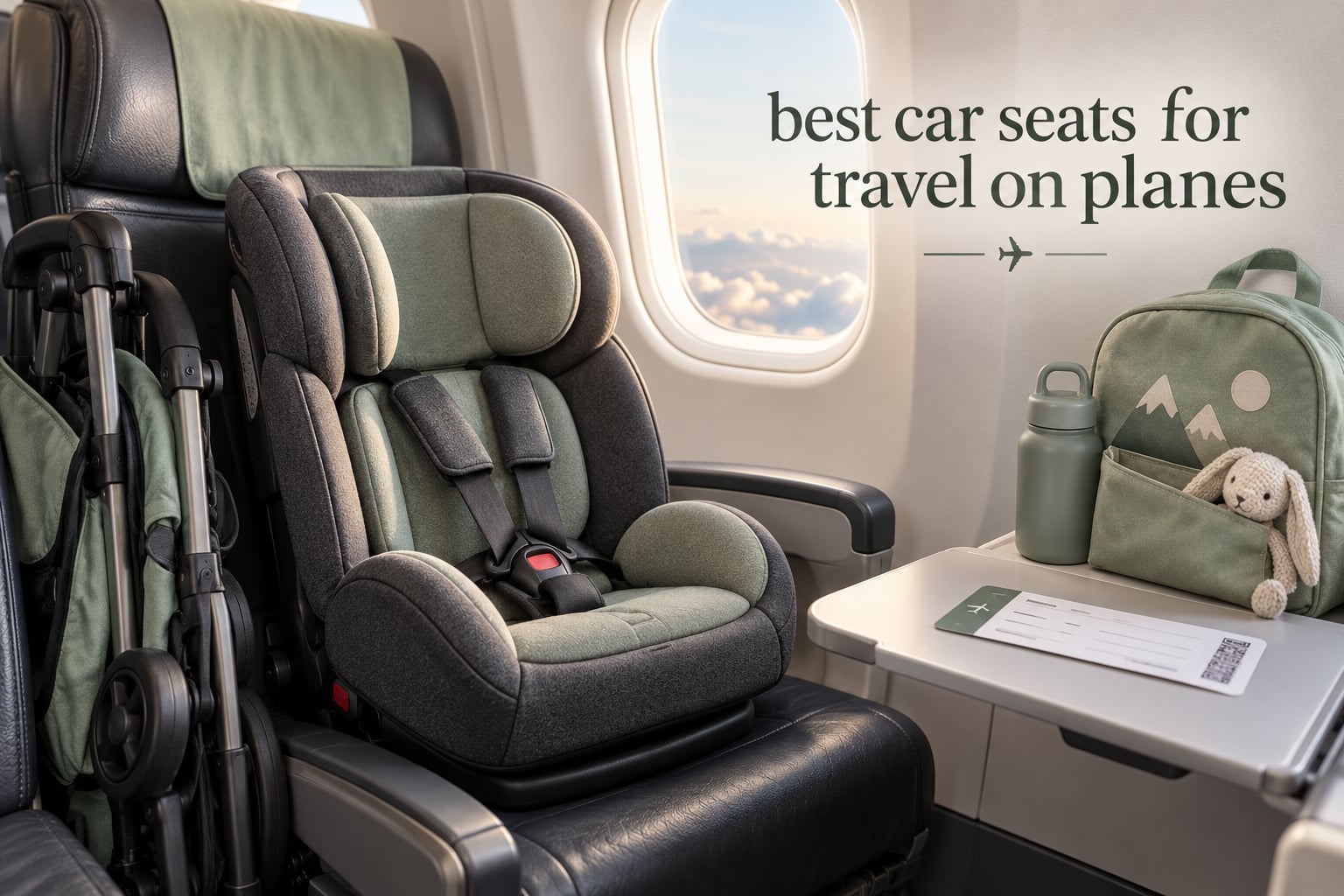
Most parents who pack a car seat for a flight are not choosing on crash performance. They are choosing on weight. A 25-pound convertible seat plus a toddler plus two carry-ons is a three-item carry that nobody enjoys, and the seat is the item with no wheels.
I have spent 2026 seasons comparing how these seats behave in an actual terminal: how heavy they feel after a long connection, whether they fit the aircraft seat, whether the install is straightforward once you are sitting in row 14, and whether the same seat still works in a rental car at the far end. This guide covers the best car seats for travel on planes across every stage a family actually travels with, from a 6-pound newborn to a 57-inch school-age kid.
Ten picks, ordered by the stage they solve rather than by brand. Each one carries its carry weight, child weight and height limits, and a plain statement of whether it is FAA approved for use on the aircraft. Where a seat is not legal on a plane, I say so, because buying a booster to use in a taxi and then trying to buckle a child into it in row 22 is a wasted purchase.
Updated for 2026. Prices change constantly, so every pick links to a live listing rather than quoting a number that will be wrong by next month.
Table of Contents
- What Car Seats Can You Actually Use on a Plane?
- Top 3 Best Car Seats for Travel on Planes (October 2026)
- All 10 Picks at a Glance in 2026
- 1. Doona Car Seat and Stroller: The Seat That Is Also the Stroller
- 2. Diono Radian 3R: One Seat From Birth to Booster
- 3. Graco Tranzitions: The Lightest Full Harness Booster
- 4. Graco TurboBooster 2.0: The One You Use After Landing
- 5. PEG Viaggio Flex 120: Folds Into the Overhead Bin
- 6. UberBoost Inflatable Booster: Fits in the Carry-On
- 7. Safety 1st Ellaris: The Narrow Convertible
- 8. CARES Air Travel Harness: A Seat Belt Solution, Not a Car Seat
- 9. BubbleBum Inflatable Booster: The Three-Across Option
- 10. Graco SlimFit3 LX: The 16.7-Inch Narrow Convertible
- How to Check the FAA Label in 10 Seconds?
- Airplane Seat Width: Why Your Seat May Not Fit?
- Gate Check, Counter Check, or Carry On
- How to Install a Car Seat on a Plane?
- How to Carry a Car Seat Through the Airport?
- Do You Need to Buy a Seat for Your Toddler?
- Frequently Asked Questions
- What car seats can I use on a plane?
- How to tell if a car seat is ok for a plane?
- Is it worth bringing a car seat on a plane?
- How do I bring a car seat on a plane?
- Is it better to gate check car seats?
- Will airlines check a car seat for free?
- Should a toddler use a car seat on a plane?
- What size car seat fits in an airplane seat?
- The Verdict for Plane Travel in 2026
What Car Seats Can You Actually Use on a Plane?
Any car seat with an FAA approval label printed on its shell can be installed on an airplane with the aircraft’s own lap belt. Infant seats go on rear-facing using a baseless belt path. Convertibles and harness-to-booster seats are fitted forward-facing with the same belt, and harness boosters are only legal on a plane in harness mode, never in booster mode. Backless boosters, inflatable boosters and vests are not permitted as on-board restraints. That is the whole rule set, and the label on the shell is where you verify it.
There is no LATCH on an aircraft. The lower anchors exist in cars because they hold a seat tighter than a belt, and aircraft do not have them, so every installation you do in row 14 is a seat belt install. That single fact explains most of the frustration parents describe in flight forums: a seat that is a ten-minute job in a driveway can be fiddly in a narrow row with a stranger watching.
The other half of the answer is what you do on the ground. Most of these families land somewhere and get into a rental car, a taxi, or a rideshare, and the restraint has to work in that vehicle too. A seat that is FAA approved and useless in a rental car because the install needs a base you did not pack is the wrong buy.
One more thing to know before you read further: the average economy seat on a narrow-body jet is roughly 17 inches wide. That single measurement decides whether a wide convertible looks bad or simply refuses to go in the row.
Top 3 Best Car Seats for Travel on Planes (October 2026)

Doona Car Seat and Stroller
- FAA and TUV approved
- Rear-facing 4-30 lb
- Converts to stroller in seconds
- 17.2 lb seat plus 9.7 lb base

Graco TurboBooster 2.0
- Backless and 40-100 lb
- Up to 57 in
- Height-adjustable armrests
- Not legal on the aircraft
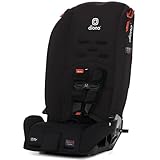
Diono Radian 3R Convertible
- Birth to 120 lb
- Four modes in one seat
- Fits three across
- Folds flat
- FAA approved
The Doona wins here because it removes the airport problem rather than making it lighter. Nothing else in this roundup eliminates a whole category of luggage.
The TurboBooster 2.0 takes the TOP RATED badge on the strength of a 4.8 average across more than 12,000 reviews, and it is the one pick here aimed squarely at the taxi queue rather than the seat belt. The Diono Radian 3R is the pick when a child is small enough to need one seat for the whole childhood and the family is not flying often.
All 10 Picks at a Glance in 2026
| Product | Specifications | Action |
|---|---|---|
| Doona Car Seat and Stroller |
|
Check Latest Price |
| Diono Radian 3R |
|
Check Latest Price |
 Graco Tranzitions Graco Tranzitions |
|
Check Latest Price |
| Graco TurboBooster 2.0 |
|
Check Latest Price |
 PEG Viaggio Flex 120 PEG Viaggio Flex 120 |
|
Check Latest Price |
 UberBoost Inflatable UberBoost Inflatable |
|
Check Latest Price |
 Safety 1st Ellaris Safety 1st Ellaris |
|
Check Latest Price |
 CARES Air Travel Harness CARES Air Travel Harness |
|
Check Latest Price |
 BubbleBum Inflatable Booster BubbleBum Inflatable Booster |
|
Check Latest Price |
 Graco SlimFit3 LX Graco SlimFit3 LX |
|
Check Latest Price |
Three things in that table are worth reading twice. First, five of these ten are not usable as an on-board restraint, because backless and inflatable boosters are car devices, not aviation child restraint devices. Second, seat width is the number that decides if a row accepts the seat, and only two listings give you a manufacturer width. Third, the Doona is the only pick that also works as a stroller, which is where its extra pounds pay for themselves.
1. Doona Car Seat and Stroller: The Seat That Is Also the Stroller
Doona Car Seat & Stroller, Nitro Black – All-in-One Travel System
Rear-facing only 4-30 lb
Seat and stroller 17.2 lb base 9.7 lb
Folded 17.4 x 26 x 22.4 in
FAA and TUV approved
Pros
- Converts from car seat to stroller in seconds with a one-click mechanism
- 3-layer side impact protection with an anti-rebound bar
- Water-repellant canopy with UPF 50+ protection
- Near-flat ergonomic infant insert for newborns
Cons
- Rear-facing only with a 30 lb weight ceiling
- Heavier than a typical travel seat at 17.2 lb
- Stroller conversion takes practice with a baby in it
This is the seat I would carry through a connection with a newborn. The whole premise is that the frame folds flat and the wheels drop down, so the same object is the infant carrier at the gate, the stroller in the terminal, and the car seat in a rental car. For families under 2 who are still rear-facing, that removes the stroller from the equation entirely.
The one-click conversion is real and it is fast, and owners consistently describe children sleeping through airport transitions because the seat never changes state. Reviewers also point to the near-flat infant insert, which supports a newborn’s upper and lower back and keeps the neck aligned in a way that most bucket seats do not.
On the plane itself, this is rear-facing only with a 4 to 30 lb range and a 5-point harness. It is FAA and TUV approved, and the shell carries fiber-reinforced polymers and rust-free aluminum. The seat and stroller weigh 17.2 lb and the separate LATCH base adds 9.7 lb, so if you are not using the stroller function and you are gate checking, leave the base at home.
Folded, it measures 17.4 by 26 by 22.4 inches. Open with the stroller frame, it is 17.4 by 32.3 by 39 in. That 17.4-inch width is the number that matters in a narrow-body row, and it is right at the edge of what a standard economy seat accepts.
What you give up for the wheels
The 30 lb rear-facing ceiling is the dealbreaker for a chunky toddler. When a child outgrows it, you are buying a second seat mid-trip cycle, which is the exact cost the stroller function was supposed to avoid. The 17.2 lb seat plus 9.7 lb base is also heavier than a dedicated travel bucket seat, so if your trips are short and terminal distances short, the conversion value drops.
Reviewers report that the conversion itself needs practice, particularly with a child in the seat, because the mechanism takes two hands and attention. Budget for standing still in a concourse once or twice before you are fluent with it.
Who should buy it and who should skip it
Buy it if you are flying with a baby under about 15 lb who still needs full recline, if you are car-light at your destination, or if your family moves through airports several times a year. The stroller function earns its weight the moment you are connecting through two airports.
Skip it if your child is approaching 30 lb, if you already own a full travel system you like, or if you fly a route with no rental car and no need for a stroller at all. In that case a dedicated bucket seat is lighter and does the same job on the aircraft.
2. Diono Radian 3R: One Seat From Birth to Booster
Diono Radian 3R, 3-in-1 Convertible Car Seat, Rear Facing & Forward Facing, 10 Years 1 Car Seat, Slim Fit 3 Across, Jet Black
5-120 lb across four modes
Rear-facing up to 50 lb
SuperLatch belt-path install
Fits three across
FAA approved
Pros
- Four modes in one seat covering birth to 120 lb
- Low-profile design genuinely fits three across
- Automotive-grade high-strength steel core shell
- Cover is machine-washable and removes easily
- Seat folds flat for travel
Cons
- Steel core makes it heavy and awkward to move between vehicles
- Mode rules are complex and easy to misuse without the manual
- Deep rear-facing recline forces the front seat well forward
The Radian 3R is the buy for a family that wants one seat for the entire childhood and flies maybe twice a year. Infant, rear-facing, forward-facing and booster in a single shell, 5 to 120 lb, rear-facing to 50 lb. Parents with three children consistently name the three-across footprint as the reason they bought it, and in a narrow aircraft row that narrowness translates directly into a seat that fits.
It is FAA approved for airline use, which means it is legal in the cabin with the aircraft belt. It uses the SuperLatch belt-path install, so there is nothing to attach and nothing to pack beyond the seat. Owners like the ComfortPlus memory foam and the fact that the harness straps adjust smoothly across years of use.
Flaws but not dealbreakers: the steel core is genuinely heavy to move between vehicles, and the four mode system has direction and weight rules that punish anyone who does not read the manual. Multiple owners recommend professional installation help for that reason. The rear-facing recline is also very deep, which means the front passenger seat has to slide well forward, and rear-facing use in the center position requires a fixed headrest.
The folding feature that lets it collapse for travel is a real convenience, but it is not a folding travel seat in the WAYB sense. It folds down, not flat into a bag.
When one-seat-for-a-decade makes sense
This seat earns its place when the alternative is buying two or three seats across a growth arc, or when three children share a vehicle and you need three-across capability. The 120 lb ceiling means it also covers the booster stage, so nothing has to be bought at the transition.
It also holds up as a two-mode decision. Families who fly with a toddler and then a preschooler can keep the same seat rear-facing to 50 lb, then flip it forward-facing with the harness to 65 lb, and only add a booster at the end.
Where the steel core works against you
Carry weight is the problem. Reviewers single it out for being awkward to move between vehicles, and in an airport that weight is felt over a long walk to a gate or a long walk from one. It is the heaviest-feeling convertible in this roundup, though the manufacturer does not publish a carry weight for it.
The install complexity is the second issue. Four modes with different rules each is a lot to manage in a rental car at midnight after a red-eye landing. If you are not willing to read the manual and check the mode chart, pick a simpler two-mode convertible instead.
3. Graco Tranzitions: The Lightest Full Harness Booster
Graco Tranzitions 3-in-1 Harness Booster Car Seat, Proof
Forward harness 26.5-65 lb
High-back booster 40-100 lb
Backless booster 40-100 lb
One-hand 9-position headrest
Pros
- Lightweight and portable for a full harness booster
- Headrest and harness adjust together in one motion
- No rethreading of harness straps
- Grows from harness to high-back to backless
Cons
- Harness mode starts at 40 lb above the earlier listed minimum
- No high-back booster coverage beyond 100 lb
Most parents buying a booster for a flight are buying it for the taxi, not the seat. The Graco Tranzitions covers that middle stage where a child is too big for a forward-facing harness car seat at home but too small to sit in a backless booster in a rental car, and it does it in a package you can actually carry.
The headline feature is the No-Rethread Simply Safe Adjust Harness System, combined with a one-hand nine-position headrest. Harness height and headrest height move together in a single motion, so you are not threading straps through a shell in an airport seat with a squirming child. Reviewers pick this out as the practical win on travel days specifically.
Weight limits are the thing to read carefully. Forward-facing harness mode runs 26.5 to 65 lb, high-back booster mode runs 40 to 100 lb, and backless booster mode also runs 40 to 100 lb. Note the raised harness minimum of 40 lb; if you have been planning on using harness mode for a smaller preschooler, this seat will not do it.
On the FAA question, the manufacturer’s listing for this model does not carry an approval statement. Verify the label on the physical shell before you book. If the label is there, the aircraft seat belt is the only install you have, since there are no lower anchors in a cabin. If the label is absent, treat it as a ground-only booster and use a seat belt booster cover only if your airline permits it.
The stage it fills that nothing else does
A child between roughly 40 and 65 lb in a rental car is the hardest stage to solve, and this seat solves it with a real five-point harness rather than a belt-positioning cushion. That matters on a road trip after landing, when belt fit on a 45 lb child is poor and the shoulder belt rides across the neck.
The no-rethread system also survives the years. A harness that has to be rethreaded every time a growth spurt happens is a harness parents stop adjusting properly, which is worse than a slightly loose one you fix twice a year.
The limits worth knowing before you commit
There is no high-back booster coverage beyond 100 lb, so an older child ends up in backless mode or a different seat. The 40 lb harness minimum is also a genuine change from what many parents expect for a harness booster, and it means the seat is not usable in the flight phase where a two-year-old might still be in a harness.
The absence of a published FAA statement is the biggest practical caveat. Check the shell before you commit, and be aware that booster seats in general are not aviation child restraint devices even when a label exists.
4. Graco TurboBooster 2.0: The One You Use After Landing
Graco TurboBooster 2.0 Backless Booster Car Seat, Denton
Backless booster 40-100 lb
Up to 57 in tall
Ages 4-10
Height-adjustable armrests
Pros
- Small and light enough to stow in a bin or under an airplane seat
- Height-adjustable armrests improve belt positioning
- Graco ProtectPlus Engineered frontal rear and rollover testing
- A 4.8 average across more than 12000 reviews
Cons
- Backless only so no head or shoulder support
- Not permitted as an on-board restraint
Be clear about what this is. The TurboBooster 2.0 is not a seat you use in row 14. It is a booster for a child who has outgrown a forward-facing harness, and its job is the rental car, the taxi, the rideshare and the family car at home. Parents in travel forums describe it as the thing that stays with the checked bag while the child restraint goes in the cabin.
What makes it travel-friendly is its size. A backless booster is small enough for an overhead bin or under the seat in front of you, which means you are not adding a bulky box to a personal item allowance. Across more than 12,000 reviews it holds a 4.8 average, and owners point to easy belt routing and a durable build.
The height-adjustable armrests are the feature that separates it from a foam wedge. They guide the lap belt into position across the child’s thighs rather than the stomach, which is the entire difference between a booster that works and one that is decorative. The ProtectPlus Engineered programme covers frontal, rear and rollover crash scenarios plus New Car Assessment Program and extreme interior temperature testing.
Limits are 40 to 100 lb and up to 57 inches, for ages roughly 4 to 10. Those are solid numbers for a road trip, and they mean most children in this range can use the same booster for the whole journey.
Why a backless booster earns its bag space
Once a child is over 40 lb and 57 inches, a high-back booster adds head and shoulder support that a backless model does not offer. But that support is not what protects them in a crash; belt fit is. On a long-haul flight followed by a long drive, the flat, small profile wins because the child is comfortable, which is most of the battle.
It also fits three across more easily than anything with wings. Families with three kids in a rental car or a minivan notice this immediately.
Where it falls short
There is no head or shoulder support by design, so a child who falls asleep on a long drive has nothing to rest against. If your child sleeps in the car, a high-back booster is a better long-term answer even though it is a worse travel pack.
And to repeat the point clearly: this is not a legal restraint on an aircraft. Buckling a child into a backless booster in an airplane seat does not meet any aviation requirement, and the seat belt in a plane row is a poor fit for a 40 lb child in the first place.
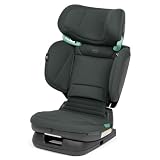
5. PEG Viaggio Flex 120: Folds Into the Overhead Bin
PEG Viaggio Flex 120 High Back Folding Booster, Metal (Sage Green)
Folds to 9.8 in high and 16 lb
40-120 lb
Unfolded 26.5 x 12 x 17 in
Aluminum-reinforced backrest
Pros
- Folds to about 9.8 inches high so it fits an airplane overhead bin
- Built-in carry handle
- Armrest-free design lets children self-buckle and fits more seats per row
- Slim seat bottom helps position the lap belt
Cons
- At 16 lb it is heavier than inflatable or backless alternatives
- Recline and belt positioning take getting used to
The Viaggio Flex 120 is the pick when the deciding factor is the overhead bin. It folds down to 9.8 inches tall, which is low enough to sit on top of a roller bag in the bin rather than becoming its own problem, and it has a carry handle built into the frame. For a family that refuses to gate check a car seat, that is the whole argument.
It is also a real high-back booster rather than a wedge. The 4D Total Adjust system moves the headrest, upper backrest, side wings and recline independently, and the aluminum-reinforced backrest gives it a sturdier feel than foam or inflatable alternatives. The seat runs 40 to 120 lb across five reclining positions.
Unfolded it measures 26.5 by 12 by 17 inches, so it is 17 inches wide at the base. That is a standard narrow-body width, which makes it a realistic prospect in economy rather than a purchase that only works in a wide cabin. It also has integrated rigid LATCH connectors, so at your destination you are not dealing with loose strap hooks.
The 100 percent flame-retardant construction is a detail airlines and cruise lines ask about, and it is rare in this category.
Armrest-free is the clever part
Removing the bulky armrests does two things. Children can climb in and buckle themselves, which is a genuine time saver in a rental car lot, and more boosters fit across a back row, which matters if you are traveling with siblings. The slim seat bottom also helps the lap belt sit low on the hips rather than across the stomach.
The four-way independent adjustment is what keeps it useful for a few years. A two-position headrest is fine for a six-month trip and a nuisance over three years.
Where it disappoints
Sixteen pounds is real weight. It is heavier than the inflatable options and the backless boosters in this roundup, so the folding convenience comes with a carrying cost. Reviewers also note that the recline and belt positioning take some practice to get right, and this seat has the lowest average rating in the group with a 9 percent one-star share among 432 reviews.
The smaller review count matters too. Fewer owners means less long-term feedback on the folding mechanism and the aluminum frame, so for a seat you intend to keep for years it carries more uncertainty than a similarly rated product with five times the reviews.
6. UberBoost Inflatable Booster: Fits in the Carry-On
UberBoost Inflatable Booster Seat for Car, Travel Booster Seat, Black/Gray
Inflates in under 20 seconds
40-120 lb
Deflates into its own travel bag
Meets or exceeds FMVSS 213
Pros
- Inflates in seconds and rolls up for carry-on or backpack packing
- Narrow enough to fit three across in smaller vehicles
- Non-skid base stays stable on leather and vinyl upholstery
- Meets or exceeds FMVSS 213
Cons
- No head or shoulder support as a backless booster
- Needs inflating at every use and can lose firmness over time
The UberBoost exists to solve one problem: you cannot bring a booster if it takes up half a suitcase. It deflates, rolls into its own travel bag, and inflates by mouth in under 20 seconds, so it lives permanently in a bag until a vehicle needs it. Across more than 7,600 reviews it holds a 4.5 average, and owners credit the pack-flat design for letting them skip gate checking a car seat entirely.
The non-skid base is the detail most people only notice when it works. Rental cars are frequently leather or vinyl, and a booster that slides around under hard braking is worse than no booster. Positioning clips keep the lap belt off the abdomen, which is where the fit problems usually start.
Weight capacity is 40 to 120 lb, and the narrow profile fits three across in smaller vehicles. It meets or exceeds FMVSS 213, the federal motor safety standard for child restraint systems, which is the relevant certification on the ground.
Like the other backless options here, it is not a legal on-board restraint. Use it in a rental car, a taxi, or a rideshare, not in a plane seat.
When nothing else will fit in the bag
Travel light and the UberBoost is hard to argue with. It weighs nothing in the bag, it needs no tools, and it inflates with a few breaths in a taxi queue rather than in a parking structure. Families who fly with two kids, two suitcases and a stroller find this the only booster that does not force a decision.
It is also a cheap second booster. A family with three children can carry two of them at essentially zero weight cost.
The trade you accept
There is no head or shoulder support, so a sleeping child has nowhere to rest. The material is polyester inflatable cushioning, and reviewers report that it can lose firmness over time and needs inflating at every single use, including short rides to the airport.
For a four-hour flight followed by a two-hour drive, that is a fine trade. For a family whose main travel mode is flying and whose ground transport is a train, a folding high-back booster is the better tool.
7. Safety 1st Ellaris: The Narrow Convertible
Safety 1st Ellaris 3-in-1 Convertible Car Seat, Slim Fit Design, Rear & Forward-Facing, 5-Position Headrest, Travel-Friendly with Machine-Washable Seat Pad, London Blue
Rear-facing infant 5-30 lb
Rear-facing toddler 30-40 lb
Forward harness 30-65 lb
5-position headrest
Pros
- Slim shell fits airplane seat rows where wider convertibles will not
- Machine-washable and dryer-safe seat pad
- Airplane-ready compact design
- Two removable dishwasher-safe cup holders
Cons
- No booster mode so a separate seat is needed later
- Fit recline and installation are the most common complaints
The Ellaris is the seat to look at when a wide convertible will not go into the row. The slim shell is the entire product concept, and owners consistently describe it as fitting standard airplane seat rows where bulkier convertibles are refused. That is a real constraint that parents discover at the gate rather than in a showroom.
It covers three modes: rear-facing infant from 5 to 30 lb, rear-facing toddler from 30 to 40 lb, and forward-facing harness from 30 to 65 lb. The five-position headrest and harness grow with the child across all three. It is engineered and tested to meet or exceed federal safety standards and meets the federal side impact standard.
The practical details are unusually good for a seat at this level. The seat pad is machine-washable and dryer-safe, and the two cup holders are removable and dishwasher-safe. Those two features matter more on a trip than any spec sheet, because a spilled formula in a car seat is a certainty.
Flaws but not dealbreakers: this is the lowest average rating in the group at 4.3, with an 8 percent one-star share. Dissatisfaction clusters around fit, recline and installation rather than safety, and there is no booster mode, so a separate seat is needed later in the arc.
Fit for the newborn phase
The 5 lb rear-facing lower limit with a 5-position headrest makes this a genuine newborn seat rather than a toddler seat with a low minimum. For a family flying with a 6 to 12 pound baby and no other restraint at the destination, that is the useful part of the spec.
Hook-style LATCH is the lower anchor system, and on a plane you ignore it entirely and use the aircraft belt.
Where the rating gap shows up
At 4.3 across roughly 1,600 reviews, this is a value seat with a real trade. Recline adjustment and general fit generate the negative reviews, and the one-star share runs higher than the convertible seats here. If you are installing a newborn seat in the dark in an unfamiliar rental car, a seat with a simpler recline is a calmer experience.
Buying it as a travel-only seat that you hand down later is a reasonable strategy, since the lack of a booster mode stops mattering once you have already bought the next seat.
8. CARES Air Travel Harness: A Seat Belt Solution, Not a Car Seat
Child Airplane Travel Harness – Cares Safety Restraint System – The Only FAA Approved Child Flying Safety Device
FAA approved child aviation restraint
Positions child with the adult lap belt
Packs in a backpack or diaper bag
Installs in minutes
Pros
- The only FAA approved child aviation restraint in this roundup
- Eliminates the car seat from your luggage entirely
- Attaches to most standard airplane seats in minutes
- Keeps the child positioned through takeoff landing and turbulence
Cons
- Plane use only a separate car seat is still needed on the ground
- Airlines may still require a separate seat or advance notice
This is the answer for parents who ask whether a car seat is even necessary on a plane. The CARES harness is an aviation child restraint device that positions a child using the standard adult lap belt, and it is the only product in this roundup whose approval is for air travel specifically. It holds a 4.4 average across roughly 2,700 reviews.
The logistics are the appeal. It packs into carry-on luggage, a backpack, or a diaper bag, attaches to most standard airplane seats in minutes, and removes just as fast for the walk to the lavatory. Parents credit it with avoiding a gate-checked car seat entirely, which removes the single largest source of travel stress for them.
It works because the adult lap belt does the restraining rather than a separate shell. The harness routes the belt into a position that holds a small child correctly through takeoff, landing and turbulence. It is designed for longer flights rather than quick hops.
Two cautions. First, it is plane-only, which means if you land somewhere and get into a rental car, you still need a real car seat. Second, airlines may still require a separate purchased seat or advance notification, so check your carrier’s policy before assuming the harness alone satisfies them.
When it is the right tool
Travel light is the obvious case. Families who fly to a destination where they will use taxis, transit and walking rather than a rental car gain the most, because the harness handles the flight and nothing else is needed. It is also the only pick here that works for a child who is too small for any booster and has already outgrown an infant seat.
It is equally good as a companion to a car seat that you gate check. The harness goes in the cabin, the car seat goes in the hold and arrives for the drive.
What it does not solve
It provides no head or shoulder support and no recline, so a sleeping toddler is upright for the entire flight. Reviewers also report a 15 percent four-star share, with the common note that some children find the fit snug, and a smaller group reporting confusion with airline notification rules.
And the ground transport question remains. If the first thing you do after landing is drive a rental car, this does not remove your need for a car seat. It only removes the need to carry one through the terminal.
9. BubbleBum Inflatable Booster: The Three-Across Option
BubbleBum Inflatable Travel Booster Car Seat, Narrow Backless, 40-110 lbs
Inflates by mouth in about 20 seconds
Deflates to 12 x 6 x 4 in
40-110 lb ages 4-11
Secured by standard 3-point belt
Pros
- Inflates in about 20 seconds with no pump and collapses to 12 x 6 x 4 in
- Independently crash tested to exceed FMVSS 213
- Uses the standard 3-point seatbelt with no LATCH or extra hardware
- Narrow enough for three across in compact cars SUVs and minivans
- Wipes clean after snacks
Cons
- No head or shoulder support as a backless booster
- Long-term firmness and cushioning draw the lowest four-star share in the group
The BubbleBum is the booster for a family that has three children and one minivan seat row to fill. It is narrow enough to sit three across in compact cars, SUVs and minivans, which is the situation where a high-back booster simply does not fit. Across nearly 6,900 reviews it holds a 4.3 average, and the three-across fit is the reason owners give for buying it.
Unlike the UberBoost, this one uses the standard three-point seat belt, so there is no separate lap belt to route and no LATCH or extra hardware to pack. It secures directly with what the vehicle already has, which removes a whole category of install error in an unfamiliar car.
It inflates by mouth in about 20 seconds with no pump, and deflates to 12 by 6 by 4 inches, which is smaller than most carry-on allowances for the item itself. Weight capacity is 40 to 110 lb for ages 4 to 11, and it is independently crash tested to exceed FMVSS 213.
The wipe-clean cushion earns its keep on a road trip. Snacks happen, and a foam wedge absorbs them permanently.
Three across is the deciding feature
For a family with three children in one vehicle, a booster that takes a full seat width is not a purchase, it is an impossibility. The slim profile here solves that in a way no high-back booster in this roundup can, and it does it with a belt the car already has.
It is also the least complicated item to explain to an older child: get in, buckle up, done.
Where it earns its budget badge
No head or shoulder support, by design, and the ratings reflect some wear over time. This seat carries the largest four-star share in the group at 15 percent, which points to mixed experiences around long-term firmness and cushioning, and it has an 8 percent one-star share.
For occasional flights and rental car use, that is an acceptable trade for three-across capability and a 12-inch packed size. For a child who sleeps in the car, a high-back option ages better.
10. Graco SlimFit3 LX: The 16.7-Inch Narrow Convertible
Graco SlimFit3 LX 3-in-1 Convertible Car Seat, Kunningham
16.7 inches wide
Rear-facing 5-40 lb
Forward harness 26.5-65 lb
High-back booster 40-100 lb
Pros
- Manufacturer states 16.7 in width which matters in an airplane row
- Fits three car seats across the back seat
- 10-position no-rethread harness
- Graco ProtectPlus Engineered side impact testing
Cons
- Rear-facing recline can be hard to set far enough back for a newborn
- Side openings in the shell let cabin air blow at the child's legs
- Plush padding can run warm
The SlimFit3 LX is the only convertible in this roundup where the manufacturer publishes a width, at 16.7 inches, and that single number is why it is worth considering at all for air travel. Anything wider than roughly 17 inches starts to have a problem in a narrow-body row, and 16.7 inches leaves room to spare.
It is also a genuine three-across seat, and reviewers describe the practice of buying it for each child and handing seats down between vehicles. Modes cover rear-facing harness 5 to 40 lb, forward-facing harness 26.5 to 65 lb, and high-back booster 40 to 100 lb. The 10-position No-Rethread Simply Safe Adjust harness handles height changes without rethreading.
It holds a 4.8 average across roughly 2,200 reviews with a 90 percent five-star share, and owners highlight simple installation, removal, adjustment and machine washing across years of use. The Graco ProtectPlus Engineered programme is tested to the newest side impact testing standards.
Flaws but not dealbreakers, and they are physical rather than safety-related: the rear-facing recline can be hard to set far enough back for a newborn without help, openings in the sides of the seat back let air conditioning blow directly at the child’s legs, and the plush padding can run warm on a long flight.
When the published width settles the question
Comparing seats for a plane is mostly comparing widths, and most listings do not give you one. This one does, which removes the guesswork from the only measurement that determines whether the seat physically fits. If a manufacturer tells you 16.7 inches, you can plan around a standard economy row with confidence.
Three-across capability in a rental car is the second argument. A family that arrives with two or three children and a single full-size rental car needs seats that sit side by side.
Small comfort issues on a long flight
The side vents are the most-cited annoyance and they matter more in a plane than in a car, because cabin air is cold and constant. Parents wrap blankets around the shell or use a seat liner to block the airflow. The plush padding running warm is the opposite problem and shows up more in hot destinations.
The newborn recline is the third issue, and it is the one to check before buying for a baby. Setting the recline far enough back for a small infant is awkward in a car and worse in a rental car at night.
How to Check the FAA Label in 10 Seconds?
Every aviation-approved car seat carries a printed label on the back of the shell. Find it before you pack, not at the gate.
Look at the back or underside of the seat shell for a rectangular label with red text.
Read the line that says the seat is approved for use on aircraft, usually within the first two lines.
Check that the label is a real sticker moulded into the shell, not a printed graphic or a marketplace photo.
Confirm the model number and manufacture date on the same label match the seat you are packing.
Check the expiration date, which is printed on the same label. A seat past its expiration date should not be used in a car, and airlines will not accept an unlabeled or expired one.
If you cannot find a label, treat the seat as ground-only. No reputable manufacturer ships a car seat without one, so a missing label is a reason to return the product rather than a reason to hope.
One safety note that parents raise repeatedly in forums: there is a visible trade of counterfeit and unbranded restraint devices sold on third-party marketplaces. These are not cheap versions of a real seat, they are unverified objects that may not have been crash tested at all. Buy from a seller with a real return history and never from a listing that prices a restraint far below the market. If you want a cross-check on what a legitimate listing looks like, our picks for newborn car seats and infant car seat safety-tested reviews show the level of labeling and documentation a real product listing carries.
Airplane Seat Width: Why Your Seat May Not Fit?
The average economy seat on a narrow-body jet is about 17 inches wide. That number is the reason parents in travel forums report that a rear-facing seat which fits fine at home will not sit flush in their row, and it is the single most under-covered topic in this category.
The aircraft that cause the most trouble are the A319, A320 and B737, which are the workhorses of short and medium haul leisure routes. Parents describe a Nuna-style bucket seat and other wide rear-facing shells being unable to sit flush against the armrest in those rows, which produces a noticeably sloppier belt install. Aircraft with older metal seating, such as the E175 and the B777, and rows in economy plus, tend to give you a little more room.
Two seats in this roundup publish a manufacturer width, and that is the shortcut worth taking. The Graco SlimFit3 LX is 16.7 inches wide, which leaves margin in a standard economy row. The PEG Viaggio Flex 120 is 17 inches at the base, which is right at the limit and works in most rows but not all. The Doona is 17.4 inches folded, which is wide enough that it is worth confirming your aircraft before you commit.
There is a second factor beyond width: the belt itself. Aircraft lap belts are shorter and sit lower than car belts, and rows with a fixed seat cushion do not recline. This is why installing with a flight attendant present is worth the small delay, and why seats with deep recline and thick padding install worse in a row than they do in a driveway.
Gate Check, Counter Check, or Carry On
Most carriers treat a car seat and a stroller as free checked items, and both can usually be gate checked as well. The free checked bag allowance for child restraints is standard across US carriers, but the way it is applied varies by airline and airport, so confirm with your carrier rather than assuming.
Gate checking means handing the seat over at the jet bridge and picking it up at the belt claim carousel on arrival. Counter checking means checking it with your luggage at the ticket counter. Gate check is generally the better choice for a car seat because the ramp crew handles it separately and with more care than a conveyor belt, which is the conclusion most parents in parenting forums reach independently. It also means you are not standing at the counter deciding whether to pay for an oversized bag.
You can gate check a car seat and a stroller, usually on the same tag or adjacent tags, and both are handled at the oversized belt claim rather than the regular carousel. A gate-checked car seat also travels free on most carriers regardless of your fare class, while the stroller is a separate item.
If a seat comes back damaged, take photographs of the shell, the harness webbing, the buckle and the label before you leave the baggage area, and file a report at the airline’s baggage service desk before leaving the airport. Damage claims filed hours later are far harder to support. A car seat involved in a crash or a hard impact should not be reused regardless of what it looks like, and a car seat with a frayed harness strap is finished.
How to Install a Car Seat on a Plane?
There are no lower anchors on an aircraft, so every on-board install is a seat belt install. That one fact removes all the LATCH equipment from the conversation.
Place the seat in the window seat if you have the choice, and push it back against the seat in front for the most stable base.
For an infant seat, use a baseless install. Route the aircraft belt through the European belt path, which runs under the seat back through the shell, rather than the American routing that runs behind the seat back.
For a convertible or a harness booster in harness mode, place it forward-facing and route the belt through the forward-facing belt path, then lock the belt with the seat’s own lock-off or a locking clip.
Feed the belt through the correct path with the buckle on the inboard side, where the belt is longest, and add slack by pulling the belt tail out of the retractor rather than by adjusting the seat.
Ask a flight attendant to look at the install before takeoff. They do this routinely, it takes under a minute, and a second pair of eyes catches a slack belt path faster than anything you can do yourself.
Two things not to do. Never use a locking clip with a European belt path install, and never put a harness booster into booster mode on a plane, because booster positioning is not an approved configuration on an aircraft even when the seat carries an approval label.
If you are installing in a rental car at the destination, the aircraft belt experience transfers directly. The same belt path, the same lock-off, and a vehicle that is almost always wider than the plane.
How to Carry a Car Seat Through the Airport?
The reason dedicated travel seats exist is the terminal walk. Five methods solve it, in rough order of how well they work.
A dedicated travel cart is the best option and the one most families never consider. Editors at major consumer publications describe pushing a seat through the concourse exactly like a stroller, and it is the only method that works with a heavy everyday convertible rather than a purpose-built light seat. It is also a separate purchase, which is why plenty of families instead rent a hand truck or luggage cart from an airport shop near security.
A bungee cord or luggage strap around a rolling carry-on works for a booster or a folded lightweight seat. Strap it on, tilt the bag, and roll. An IIHS researcher has recommended exactly this arrangement, and it costs almost nothing.
A car seat backpack carrier is the answer when a second adult is not available. It works with lightweight seats rather than heavy convertibles, and it is worth checking the weight rating before you buy.
Hanging a booster from stroller handles is the cheapest method and it works well for backless and inflatable boosters, which are small and light. It stops working as soon as a stroller is folded for the hold.
For a solo parent with a toddler, the honest answer is that the terminal walk is the hardest part of flying with a small child, and the stroller-style conversion on the Doona exists precisely because it is so difficult. Plan the route, use a cart if you can find one, and accept that the last 200 meters are the hard part.
If you are still working out what a booster is for versus a harness seat, our best booster car seats expert reviews covers the size ranges, and our lumbar pillows for car seats guide helps with the posture problem on long flights.
Do You Need to Buy a Seat for Your Toddler?
You do not have to buy a separate seat. Under 2, a lap infant is permitted on US domestic flights, and many carriers allow it internationally as well, though rules vary. The trade is that a lap infant cannot be restrained during takeoff, landing and turbulence except by holding them, and it is a two-adult-hand situation at the worst possible moment.
Buying a paid seat for a toddler and bringing a car seat is the safer and calmer option, and it is the only option that gives the child their own restraint for the whole flight. The cost question is real, and it is the reason many families buy a paid seat for the toddler and still gate check the car seat rather than carrying it into the cabin.
A middle path exists for a two-year-old: buy a paid seat for the child but use a booster seat cover for the flight, then use a harness booster or car seat in the rental car at the destination. This is not a substitute for a restraint in a crash, and it is only appropriate when the child’s size and the seat’s design make belt fit reasonable. Check with your airline before relying on it.
The CARES harness changes the calculation for families flying to car-light destinations, because it gives a small child a real in-flight restraint without a car seat. If you are landing in a country with strict taxi and rideshare rules, budget for a car seat anyway, because a belt-positioning device you can buy locally is far easier than one you carried across an ocean.
There is a related question parents ask about gate checking: is it better to gate check a cheap dedicated travel seat than to check a good everyday seat? Most parents who have done both say gate checking a lighter second seat is the better balance, because damage risk scales with handling rather than with price.
Frequently Asked Questions
What car seats can I use on a plane?
Any car seat with an FAA approval label on the shell can be installed on an aircraft using the plane’s own lap belt. Infant seats install rear-facing with a baseless belt path, and convertible or harness booster seats install forward-facing. Harness boosters are only legal on a plane in harness mode, never in booster mode. Backless boosters, inflatable boosters and vests are not permitted as on-board restraints.
How to tell if a car seat is ok for a plane?
Look for the printed FAA approval label on the back or underside of the seat shell. It should state that the seat is approved for use on aircraft, and it also carries the model number, manufacture date and expiration date. If the label is missing, the seat is ground-only. Check the label before you pack, not at the gate.
Is it worth bringing a car seat on a plane?
It depends on your child and your ground transport. If you land somewhere with a rental car, taxi or rideshare, you need a restraint, and bringing your own is often easier than sourcing one. If you fly to a car-light destination and use the CARES harness in flight, a car seat is optional. A dedicated lightweight travel seat is easier to carry than a heavy everyday convertible.
How do I bring a car seat on a plane?
Most carriers treat car seats as free checked items, and you can either check at the ticket counter or gate check at the jet bridge. Gate checking is usually handled more carefully because the ramp crew takes the seat separately. You can also bring it into the cabin and install it with the aircraft seat belt, which is legal when the shell carries an FAA approval label.
Is it better to gate check car seats?
Gate checking is usually the better option for a car seat because the ramp crew handles it off the conveyor and it avoids oversized bag charges at the counter. Parents on travel forums consistently prefer it. You pick the seat up at oversized belt claim on arrival. Photograph the seat before you leave the airport in case it comes back damaged.
Will airlines check a car seat for free?
Yes, most US carriers allow child restraints to be checked free of charge, whether at the counter or at the gate, regardless of fare class. Strollers are also free. Policies differ internationally and on low-cost carriers, so confirm with your airline before you travel. A stroller and a car seat can normally be gate checked together at the same gate.
Should a toddler use a car seat on a plane?
If you buy your toddler a paid plane seat, a car seat or an approved aviation harness is the safest way to fly them. Under 2, a lap infant is generally permitted but cannot be restrained during takeoff, landing and turbulence. A booster seat cover is not a restraint. Many families buy a paid seat for the toddler and gate check the car seat, which keeps the child safe and the luggage manageable.
What size car seat fits in an airplane seat?
A standard economy seat on a narrow-body jet is about 17 inches wide, so anything under that width fits most rows. A319, A320 and B737 rows are the tightest, while older metal seating on the E175 and B777, and economy plus rows, give you more room. Check the published width of the seat before you buy, and confirm you can push the shell flat against the armrest.
The Verdict for Plane Travel in 2026
The best car seats for travel on planes split cleanly by stage, and the winner changes depending on how old the child is and whether you land somewhere you will drive.
For a baby under about 30 lb, the Doona is the pick. It is the only seat in this roundup that removes the stroller from your luggage, and that is worth more than a few pounds of carry weight. For a child who needs a five-point harness in a rental car and you fly rarely, the Diono Radian 3R covers birth to 120 lb in one seat. For a family who wants a published 16.7-inch width and three-across capability, the Graco SlimFit3 LX is the narrowest convertible with a manufacturer figure. For a child over 40 lb who only needs a booster on the ground, the Graco TurboBooster 2.0 is the one to pack, and the UberBoost or BubbleBum if bag space is the constraint. For travel to a car-light destination, the CARES harness is the only option here approved for air travel on its own.
Whatever you choose, check the FAA label before you pack, measure your aircraft row rather than assuming, and ask a flight attendant to look at the install. Those three steps prevent almost every problem families report about flying with a car seat.
Our best booster car seats expert reviews and newborn car seat honest reviews cover the size stages in more depth if you are still narrowing down what your child needs.