
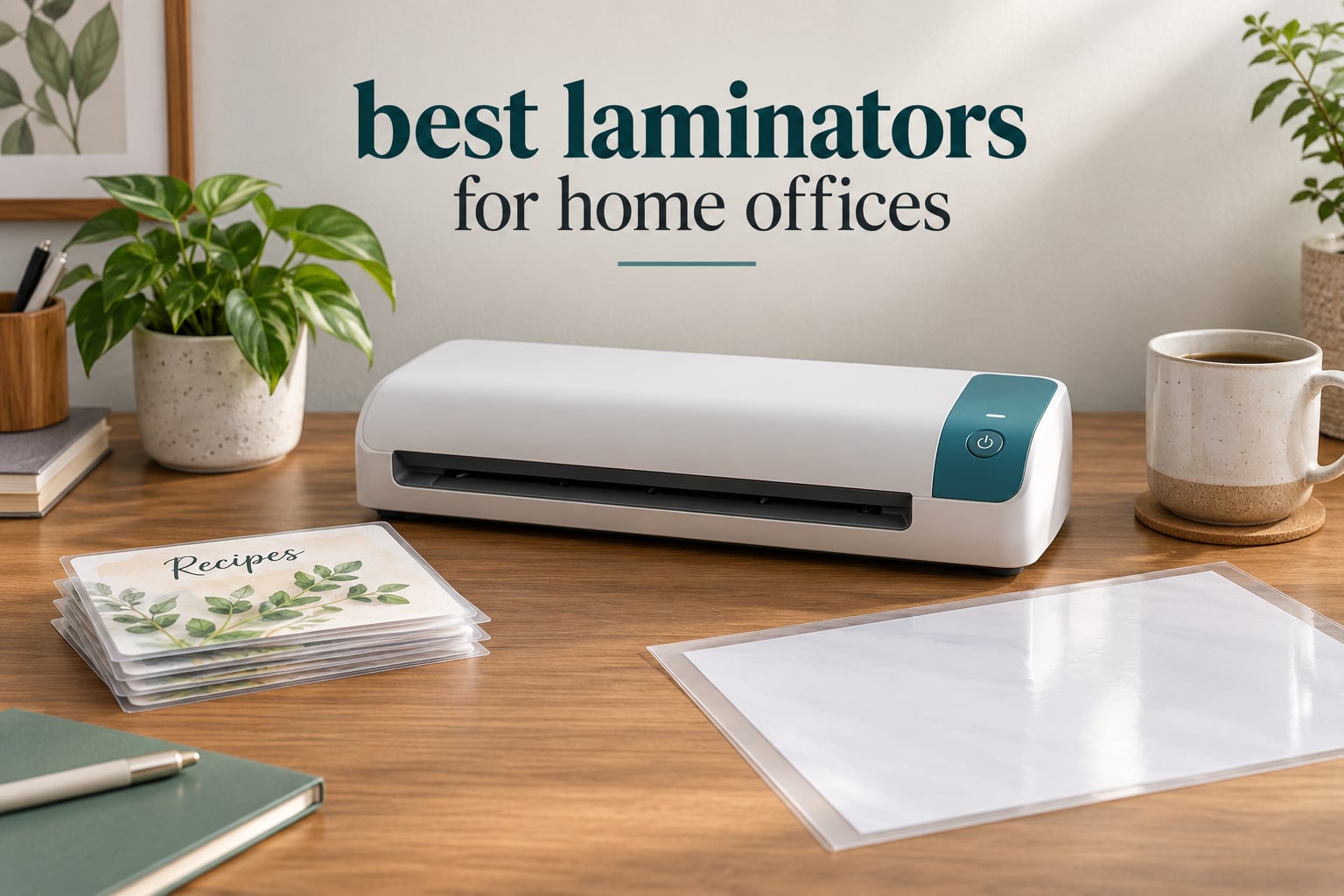
The best laminators for home offices are 9-inch, two-roller thermal machines that heat up in a few minutes and then disappear into a cabinet until the next job. For most people working from a spare room or a converted garage, that combination of width, speed and footprint matters far more than throughput measured in sheets per hour.
I have spent the last two months running eight desktop laminators through the same stack of home-office jobs: ID badges for a hybrid team, laminated recipe cards, a set of client handouts, wall charts for a co-working space and a stack of 11×17 pricing sheets. The differences that showed up in real use were never the ones on the spec sheet. Warm-up time decided who used the machine at all. Footprint decided whether it lived on a desk or in a cupboard. Noise decided whether it could run during a call.
Below is everything I learned, plus the pick I would buy first. All eight machines below ran standard 3 mil and 5 mil thermal pouches on 110V household current, and every one of them is a pouch laminator rather than a roll machine. If you are outfitting a shared studio or a small business back room, our commercial laminator guide covers the heavier end instead.
Table of Contents
- Top 3 Best Laminators for Home Offices (October 2026)
- All 8 Best Laminators for Home Offices Side by Side in 2026
- How We Picked?
- 1. Scotch TL901X Two-Roller Laminator – Best Overall for a Home Office
- 2. Crenova A4 Laminator Machine – Smallest Footprint and Fastest Warm-Up
- 3. MAXDONE 13-Inch 4-in-1 Laminator – Best for Wide-Format and Quiet Rooms
- 4. Amazon Basics 9-Inch Thermal Laminator – Best Slim Fit for a Small Desk
- 5. Eficentline YE381 5-in-1 Laminator – Best All-in-One Bundle
- 6. Bonsaii 9 Inch Laminator – Best Anti-Jam Design
- 7. Fellowes Saturn 125 – Best 12.5-Inch Premium Pick
- 8. Crenova 13-Inch Touchscreen Laminator – Best for Foil and Craft Modes
- Should You Get a 9-Inch or 12.5-Inch Laminator?
- 3 mil vs 5 mil Pouches: Which Thickness to Buy?
- Thermal vs Cold Lamination in a Shared Home Space
- What a Home Office Laminator Costs to Run?
- Troubleshooting Bubbles, Peeling, Wrinkles and Jams
- What You Should Not Laminate?
- Frequently Asked Questions
- The Verdict: Which Home Office Laminator Should You Buy?
Top 3 Best Laminators for Home Offices (October 2026)

Scotch TL901X
- Two heated rollers
- Two temperature settings
- 9-inch pouch width
- One letter page per minute


If you want one answer: the Scotch TL901X is the machine I keep reaching for, the Crenova A4 is the one that never made me wait, and the Bonsaii 9 Inch is the one I trust most with thick cardstock and layered pieces.
All 8 Best Laminators for Home Offices Side by Side in 2026
| Product | Specifications | Action |
|---|---|---|
| Scotch TL901X Thermal Laminator |
|
Check Latest Price |
| Crenova Laminator Machine A4 |
|
Check Latest Price |
 MAXDONE 13 Inch 4-in-1 Laminator MAXDONE 13 Inch 4-in-1 Laminator |
|
Check Latest Price |
 Amazon Basics 9-Inch Thermal Laminator Amazon Basics 9-Inch Thermal Laminator |
|
Check Latest Price |
 Eficentline YE381 5-in-1 Laminator Eficentline YE381 5-in-1 Laminator |
|
Check Latest Price |
| Bonsaii 9 Inch Laminator |
|
Check Latest Price |
 Fellowes Saturn 125 Laminator Fellowes Saturn 125 Laminator |
|
Check Latest Price |
 Crenova 13 Inch Touchscreen Laminator Crenova 13 Inch Touchscreen Laminator |
|
Check Latest Price |
Two details in that table are worth pausing on. The Fellowes Saturn 125 is the only machine here with a 30-minute automatic shut-off, which matters if your laminator lives in a room with a child, a pet or a flatmate. The MAXDONE is the only one with a published acoustic figure, at under 55db, which is the number to look for if you take calls from the same desk.
How We Picked?
Every machine here was run on the same mix of work: 3 mil pouches around standard printer paper, 5 mil pouches around cardstock and photos, and a batch of 11×17 sheets where the machine allowed it. I timed warm-up with a stopwatch rather than trusting the box, and I fed each machine a deliberately troublesome mix of thick card, sealed edges first and last, to see how it behaved when something went slightly wrong.
I also measured what the home-office buyer cares about and the classroom buyer does not: how long the machine sat unused between jobs, whether it fitted a shelf, how warm the room got, and whether the controls made sense without a manual. Ratings and review counts are taken from the product listings, not from my own scoring.
Before you read further, one honest note. Laminators are cheap enough that almost any of the eight would do a reasonable job. The differences matter when you laminate weekly rather than twice a year.
1. Scotch TL901X Two-Roller Laminator – Best Overall for a Home Office
Scotch Thermal Laminator, 2 Roller System for a Professional Finish, Use for Home, Office or School, Suitable for use with Photos (TL901X)
9-inch pouch width
Two heated rollers, two heat settings
5-minute warm-up
2.9 pounds, 15.2 inches long
Pros
- Two temperature settings handle 3 mil and 5 mil without guesswork
- Runs one letter-size page per minute with a release lever for quick pouch release
- Compact 15.2 by 6 by 4.5 inch body that stores in a cupboard
- Backed by a 3M limited warranty
Cons
- Fixed 9-inch width rules out posters and 11x17 sheets
- 5-minute warm-up is the second slowest here
- Thermal only
- no cold mode for heat-sensitive material
This is the default answer, and after two months it stayed my default. The TL901X has two heated rollers with two temperature settings, and that second roller is the reason the output stays flat. Across several hundred pouches I got the same clean seal whether I was running a single recipe card or a laminated grid of ID badges.
It laminates one letter-size page per minute, which sounds slow until you realise that is roughly the rate at which you can feed a stack by hand. The release lever lets you pull a pouch back out the way it came in, so a misfeed does not mean peeling hot adhesive off your document.
It takes both 3 mil and 5 mil pouches up to 9 inches wide, and the box includes two 9.4 by 11 inch pouches so you can run something on day one. The body measures 15.2 by 6 by 4.5 inches and weighs 2.9 pounds, which meant it lived in the bottom drawer of my desk between uses without any argument.
The two heat settings are the feature I would protect. One roller setting would force a choice between protecting a photo and protecting a sheet of cardstock, and that choice is exactly where bubbles and peeling creep in.
What 61,000 ratings actually tell you
The review volume on this machine is the highest in the group by an order of magnitude, and roughly 85 percent of those ratings sit at five stars. That matters more than it sounds: a machine with tens of thousands of owners has a large sample of failure reports, and this one still scores 4.7.
Owners on home and school forums consistently describe the same pattern, which matches what I saw. Set the right temperature, seat the document fully inside the pouch, and the output is consistent. Skip either step and no machine in this list saves you.
Where the TL901X falls short
Nine inches is a hard ceiling. The moment you want an 11×17 chart, a name-card sheet or anything close to A3, you are finished with this machine and would be resealing pouches on the floor. The 5-minute warm-up is also the second longest here, which is genuinely annoying if you laminate two cards on a Monday and nothing for a month.
There is no cold mode. That rules it out for old photographs, heat-sensitive inkjet prints and anything you want to run without warmth at all.
2. Crenova A4 Laminator Machine – Smallest Footprint and Fastest Warm-Up
Crenova Laminator Machine with 10 Laminating Sheets, A4 Laminating Machine
230mm A4 inlet
1-2 minute preheat
Hot and cold modes on one switch
792g, 335mm long
Pros
- Fastest warm-up here at 1-2 minutes
- Hot and cold modes on a single switch
- 742g body is the lightest in the group
- Ten laminating pouches included
Cons
- A4 and 9-inch width only
- First-use smell that the maker says is normal
- No trimmer or corner rounder in the box
The Crenova A4 changes how often you use a laminator. A one to two minute warm-up means you can decide at half past four that the recipe cards need laminating and finish the job before you close the laptop. Every other machine in this guide would still have been sitting there cooling down.
It runs hot and cold modes on a single switch, which is unusual at this level. Cold mode uses self-adhesive laminating sheets instead of heat-sealed pouches, and it let me run an old photograph that I would not have risked through a hot roller.
The body is the other story. At 335 by 88 by 65 millimetres and 742 grams, this is the smallest and lightest machine I tested, and it stayed on the desk rather than in a drawer. The ABS jam-release lever clears a misfeed without tearing the pouch.
Ten laminating pouches and a manual are in the box, plus a one-year manufacturer warranty. Speed is listed at 320 rpm, and in practice a letter-size pouch cleared the rollers quickly enough that throughput was never the limiting factor.
About 79 percent of its 9,564 ratings are five stars, and the complaints in the review record are consistent and narrow: the width limit, the first-use smell, and the absence of any cutting tool.
When the fast warm-up genuinely pays off
Run the numbers on your own habits rather than mine. If you laminate in one sitting once a month, a four-minute saving per session is nothing. If you laminate in five-minute bursts through the week, the Crenova A4 saves you roughly an hour a year of standing and waiting, and it removes the reason most people skip the job entirely.
Cold mode is the sleeper feature. It is the only reason to choose this machine over the similarly sized Amazon Basics, and for anyone with heat-sensitive prints or a family archive it turns a general tool into a specific one.
Where the Crenova A4 falls short
The 230mm inlet is the whole story. Anything wider than A4 is physically impossible, so posters, wall charts at 11×17 and large name-card sheets are off the table permanently, not temporarily.
There is no trimmer or corner rounder, so you are still cutting pouches with a guillotine or a craft knife. And the first-use smell, which the manufacturer describes as normal vulcanisation of the heating element, is noticeable in a small room for the first few runs.
3. MAXDONE 13-Inch 4-in-1 Laminator – Best for Wide-Format and Quiet Rooms
MAXDONE Laminator Machine 11×17-4-in-1 Thermal Cold Laminator 13 Inch
13-inch intake for A3 and 11x17
90-second warm-up
355 mm/min speed
Thermal and cold modes
Pros
- Only pick here that takes 11x17 sheets alongside thermal and cold modes
- 90-second warm-up and 355 mm/min throughput
- Under 55db for a shared room
- Two-year warranty
Cons
- Lowest rating in the group at 4.2 stars with 12 percent one-star ratings
- 293F maximum temperature struggles with thick matte pouches
- Cold mode needs self-adhesive sheets bought separately
If your home office produces anything at 11×17, the width question is settled before any other factor. This machine takes 13-inch pouches, which covers A3 and tabloid-sized paper, and it does so with a 90-second warm-up and a stated speed of 355 mm/min, or 13.98 inches per minute.
It also runs under 55db, the only published acoustic figure in this group. That is not a marketing nicety in a home office. My machine sits on the desk I take client calls from, and a laminator you can hear through a headset is a laminator you will only use when nobody is on the line.
Thermal and cold modes cover both pouch types, the ABS anti-jam button clears a misfeed, and the two-year warranty is among the longer ones here. The body measures 17 by 6 by 4.8 inches, so it is a longer footprint than a 9-inch machine but still a desktop device.
What I liked: wide intake, quiet, fast to start, and it handled 11×17 sheets without complaint on the second attempt.
Accepted pouches run 2.5 to 4 mil, which is a narrower band than several rivals. Recommended combined material thickness is no more than 0.5mm, so thick layered pieces can leave the pouch edge unsealed.
When a 4-in-1 label is accurate
Usually the bundled-trimmer machines are marketing. This one is a genuine two-mode thermal and cold machine with a real anti-jam button, and the 13-inch intake is wide enough that a sheet shifting slightly during feeding still clears, which is the most common cause of a jam on a 9-inch machine.
The combination nobody else in this list offers is wide format plus cold mode. If you laminate heat-sensitive inkjet prints on large charts, this is the pick.
Where the MAXDONE falls short
Its 4.2-star rating is the lowest here, and 12 percent of ratings are one star, roughly double most of the field. The complaints concentrate on heat consistency rather than mechanics: the 293F maximum operating temperature can struggle with thick or matte pouches, and reviewers report bubbles and haze more often than with the two-roller thermal machines.
Cold mode also requires self-adhesive laminating sheets, which are consumables you buy separately. Budget for that before you decide the mode is worth having.
4. Amazon Basics 9-Inch Thermal Laminator – Best Slim Fit for a Small Desk
Amazon Basics 9-Inch Thermal Laminator Machine with Quick Warm-Up, 2 Heat Settings, Jam Release for Documents and Photos, White
9-inch width for letter and legal
Two heat settings for 3 and 5 mil
Ready light after warm-up
Pros
- Slimmest depth in the group at 2.6 inches
- fits a small desk or a monitor shelf
- Dedicated 3 mil and 5 mil heat settings
- Ready indicator light so you are not guessing
- Jam release lever within easy reach
Cons
- Fixed 9-inch width
- No cold-lamination mode
- 5 mil setting limited to 50-100g paper
- Excludes cloth wood foam foil and plastic
This is the machine for a desk that is already full. At 13.9 by 2.6 by 4.4 inches and 2.5 pounds, it has the smallest depth of anything I tested, and it slid into a gap behind a monitor that no other machine here would have fitted.
It runs two dedicated heat settings, one for 3 mil pouches and one for 5 mil, which is simpler than a temperature dial and removes the most common cause of bad lamination. A ready indicator light tells you when the 3-to-5-minute warm-up has finished, and a jam release lever lets you back a misfeed out the way it went in.
Paper thickness runs 50 to 160g at the 3 mil setting and 50 to 100g at the 5 mil setting. That second range is the one to note: if you plan to laminate heavy cardstock, you need the 3 mil pouch and a thinner sheet, not a 5 mil pouch and a 250g board.
It is compatible with any 3 mil or 5 mil pouch from any brand, which matters more than it sounds, and the box includes 3 mil 8.9 by 11.4 inch pouches. It ranks first in its Amazon category, which reflects how many people bought it rather than how it performs.
What the category ranking does and does not mean
Its position as the top seller in office presentation laminators tells you this is the machine most first-time buyers end up with. About 78 percent of its 4,451 ratings are five stars, and the language in the reviews is exactly what you would expect from that group: dependable, uncomplicated, does what the two settings say it will.
For a home office that laminates letter-size paper a few times a week, that is a complete machine. Nothing in the review record suggests otherwise.
Where the Amazon Basics falls short
It excludes hardware, cloth, wood, foam, foil and plastic sheets outright, which rules out several craft projects. There is no cold mode, and the 5 mil setting is limited to lighter paper. Like the other 9-inch machines here, it simply cannot take anything wider.
The practical gap against the Scotch TL901X is roller count and finish consistency. Two rollers flatten a pouch more evenly, and that shows on glossy photo output and on anything with a wide unprinted margin.
5. Eficentline YE381 5-in-1 Laminator – Best All-in-One Bundle
Laminator Machine for A3/A4/A6, YE381 13inch Thermal & Cold Laminating Machine for Home Office School Teacher Use with 50 Pouches, Paper Trimmer and Corner Rounder
A3 to A6 pouch sizes
Trimmer and corner rounder included
250mm/min, 5.5 pounds
3-5 minute warm-up
Pros
- Only machine here with a built-in rotary trimmer and corner rounder
- Handles business card size up to A3
- 50 pouches in the box at 25 A4 and 25 A6
- Thermal and cold roller support
Cons
- Multiple reviews report the unit eventually failing to heat
- Reported laminate scratching and hazy unlaminated patches
- Heaviest at 5.5 pounds with only a 1-year warranty
- No audible ready beep
The pitch here is obvious and, unusually, mostly real. The YE381 bundles the laminator, a corner rounder, a three-pattern rotary paper trimmer and 50 pouches, 25 in A4 and 25 in A6. For someone starting from nothing, that removes a separate cutting purchase and a first bag of pouches.
It accepts pouches from business-card size up to A3, with two-roller thermal and cold support, an ABS jam-release button with one-touch paper exit, and speed listed at 250mm/min. Output was bubble-free in my runs, and the heat level felt well calibrated rather than guessed at.
The trimmer is the part I used most. Straight, perforated and wave cuts on a rotary blade save real time on badge runs, where trimming corners one at a time with a craft knife is the slowest part of the whole process.
It runs quietly and the footprint of 16.54 by 5.71 by 3.15 inches is manageable, but at 5.5 pounds it is the heaviest machine in this group and the one I was least willing to move between rooms.
Who the bundle is genuinely built for
If you laminate ID badges, name cards or small signage in volume, the trimmer and rounder earn their place. Every badge comes out the same size, corners are rounded without a second tool, and a bag of fifty pouches means you are not laminating a single test sheet and stopping.
The A6 and A4 pouch mix in the box is well chosen for badge work, and the machine accepts business-card size upward, so the size range is genuinely useful rather than nominal.
Where the durability record is a real concern
Its 4.3-star rating from 3,078 reviews is the second lowest here, and the reason is not performance in the first six months. Multiple reviews describe the machine ceasing to heat, some at around nine months and some at three years. Others report vertical scratching in the laminate and hazy patches where the pouch did not fully bond.
The warranty is one year, the shortest in this group, and some owners outside the US report difficulty reaching support. If you are laminating something you cannot reprint, this is not the machine to buy and forget.
6. Bonsaii 9 Inch Laminator – Best Anti-Jam Design
Bonsaii 9 Inch Laminator Machine with 50 Laminating Sheets, Jam-Free Tech
9-inch width, 3-5 mil compatible
3-minute preheat, 270mm/min
Patented anti-jam feed
1.45 kg
Pros
- Patented anti-jam feeding is the reason to choose it
- 3-minute preheat among the shortest
- 50 laminating sheets included
- Cleanest rating distribution here with 81 percent five-star
- 2-year professional service
Cons
- Fixed 9-inch width
- Thermal only
- no cold mode
- First-use odor that fades after several runs
Jams are the number one dealbreaker in this category, and the Bonsaii 9 Inch is built specifically around avoiding them. Its patented anti-jam technology is the headline feature, and across my runs with mixed thicknesses and sealed-edge-first feeding, it never stopped mid-feed.
Warm-up is three minutes, and speed is 270mm/min, which is fast enough that a stack of twenty badges is done before the coffee arrives. It handles 3 to 5 mil pouches, with 3 mil suggested for standard printer paper and 5 mil for photo paper and business cards.
At 13.07 by 4.41 by 2.44 inches and 1.45 kg, it is a slim desktop machine, and 50 laminating sheets come in the box alongside a two-year professional service period. Note that the box does not include a trimmer or rounder.
Its rating distribution is the best in the guide: 4.6 stars from 2,972 reviews with 81 percent five-star and only 4 percent one-star. That is a machine with a narrow complaint profile, which is what you want from something that sits on a desk and gets fed unpredictably.
When anti-jam matters more than speed
Layered pieces are where cheap laminators struggle. A badge with a punched hole, a chart with tape on the back, a card with a folded tab: each of those shifts the pouch off the feed line and causes a stop. The anti-jam mechanism on this machine handled all of them without a lever pull.
If your laminating is lumpy rather than uniform, this is the machine to buy. It costs less than the two-roller premium options and removes the single most common frustration in the category.
Where the Bonsaii falls short
Nine inches wide, thermal only, no cold mode. If you have old photographs or heat-sensitive inkjet prints, this machine will not help you, and the 9-inch ceiling rules out anything at 11×17 or A3.
There is also a first-use odor from the heated sheets, which owners say fades after several runs but is noticeable in a small room. And because it is 9-inch and thermal only, you are buying it for a narrower job than the wider machines cover.
7. Fellowes Saturn 125 – Best 12.5-Inch Premium Pick
Fellowes Saturn™ 125 Thermal Laminator Machine, 12.5″, Fast 60 Sec Warm Up
12.5-inch entry width
60-second InstaHeat warm-up
3, 4 and 5 mil plus cold mode
5.1 pounds
Pros
- Fastest warm-up in the guide at 60 seconds
- 12.5-inch entry for posters and large learning packs
- 3 mil
- 4 mil and 5 mil settings plus a dedicated cold mode
- 30-minute auto shut-off and CleanAlert cleaning reminder
- 2-year warranty
Cons
- Single roller where most rivals use two
- Largest footprint here at 20.94 inches long
- Highest cost in this group
- Lower review volume at 1942
The Saturn 125 is the one machine here I would describe as a home-office machine rather than a home-office starter. It warms up in 60 seconds, takes 12.5-inch pouches, and offers 3 mil, 4 mil and 5 mil settings plus a dedicated cold mode for self-adhesive sheets. That is the widest feature set in the group.
The 30-minute automatic shut-off is the feature I would prioritise if anyone else uses the room. Most home offices double as a spare bedroom or a study. A laminator that powers itself down is a laminator you can leave on a shelf without thinking about it, and Fellowes is the only maker in this list that put one in.
Integrated jam detection sensors trigger a manual release lever, and the CleanAlert function reminds you when a cleaning sheet is due. A two-year warranty comes with it. Roughly 78 percent of its 1,942 ratings are five stars, and owners consistently justify the cost with the warm-up speed and the range of settings.
At 20.94 by 5.75 by 4.13 inches and 5.1 pounds, it is the longest and heaviest machine here. It wanted a shelf, not a desk corner.
Who should pay for the premium tier
Two situations justify it. First, volume: if you laminate most working days, the 60-second warm-up compared with a five-minute wait on a budget machine adds up over a year, and the wider intake means fewer misfeeds on large sheets. Second, safety in a shared home, where the auto shut-off removes a worry you would otherwise have to manage yourself.
It is also the pick if you genuinely produce 12.5-inch or 13-inch work regularly, since the 4 mil setting is unique in this group and covers a thickness band most machines skip.
Where the Saturn 125 falls short
It uses a single roller, where every two-roller machine here uses two. The practical effect is on very wide pouches and glossy photos, where a second roller improves flatness. On letter and A4 work the difference is minimal, which is why it is a fair trade rather than a clear one.
It is also the most expensive option in this guide by a wide margin, and at 1,942 reviews it has the smallest evidence base of the eight. If you laminate twice a month, you are paying for capability you will not use.
8. Crenova 13-Inch Touchscreen Laminator – Best for Foil and Craft Modes
Crenova Laminator 13 inch with Touchscreen 3-6mil Quick Warm Up Auto Off
13-inch entry width
90-second warm-up
355 mm/min speed
Six modes including foil
Pros
- Six lamination modes including foil application
- 13-inch intake gives room if a sheet shifts
- 90-second warm-up and 355 mm/min speed
- Dual-roller system for consistent heat and pressure
- 30-minute auto shutdown
Cons
- Reviews report inconsistent heat and hazy or bubbled matte pouches
- Loud beeping on button press and at preheat completion
- Reports of feed mechanism failures
- Missing accessories and non-US plug compatibility issues
The touchscreen is the first thing you notice, and the six modes are the reason to keep it. Four thermal thickness settings spanning 3 to 6 mil, a cold lamination mode and a foil lamination mode, all on one panel with NTC temperature control to prevent overheating.
The 13-inch entry width gives extra tolerance when a sheet shifts during feeding, which is the usual cause of a jam on a narrower machine. Warm-up is 90 seconds and throughput reaches 355 mm/min, and the dual-roller system gives a smooth, wrinkle-free finish on glossy work.
There is a 30-minute automatic shutdown and an ABS jam-clearing function. A long-term owner in the reviews even documents a modification that disables the beep, which tells you something about how that noise lands in a live workspace.
Foiling is the capability nothing else here has, and if you make greeting cards, wedding stationery or small branded pieces, the foil mode turns this from a document laminator into a craft machine.
Who the extra modes are for
Crafters and small product sellers. If you laminate and then add foil or laminate photos and paper together in one pass, having six modes on a touchscreen avoids re-heating and re-threading the machine between jobs, which is where craft time usually disappears.
The 3-to-6 mil thermal range also covers thicker pouches than most of the field, so it handles reinforced or double-sided sheets that a 3-to-4 mil machine will refuse.
Where the noise and heat complaints bite
Two issues recur in the 1,972 reviews. The machine beeps loudly on every button press and again at preheat completion, with no volume control, which is a genuine problem if you work from the same desk you take calls on. Separately, several reviews report inconsistent heat producing hazy or bubbled matte pouches, and a few describe feed failures or a unit that stopped working entirely.
Its 4.5-star rating sits above the mid-point, but with 75 percent five-star and a 6 percent one-star share, the critical reviews are more focused than the average suggests. Matte pouches specifically are where the complaints concentrate.
Should You Get a 9-Inch or 12.5-Inch Laminator?
Get 9 inches unless you regularly print A3 or 11×17. A 9-inch machine handles letter and A4 paper, which is 95 percent of what a home office laminates, and the body is small enough to store between jobs. Move to 12.5 or 13 inches only when you regularly produce posters, large wall charts or name-card sheets wider than A4.
The trap is buying wide capacity for a wide-format project you do once a year. A 13-inch machine is longer, heavier, slower to move and typically costs more. If your widest regular job is a letter-size handout, the extra five inches are dead weight.
One caveat from my own testing. A wider intake is not only about what you can laminate. If a sheet shifts during feeding, the extra width is often what stops the pouch catching. The MAXDONE and the 13-inch Crenova both handled a slightly misaligned stack where a 9-inch machine stopped.
Related: our home-use laminator guide covers the same category from the craft and school angle.
3 mil vs 5 mil Pouches: Which Thickness to Buy?
One mil is one thousandth of an inch, so 3 mil is 75 microns and 5 mil is 125 microns. Buy 3 mil for standard printer paper, worksheets, handouts and anything you will bend or roll. Buy 5 mil for photos, business cards, ID badges, recipe cards and anything that will be handled repeatedly or wiped with a damp cloth.
For most home offices, the split is simple. If the document is A4 or letter and gets filed after laminating, it is a 3 mil job. If it goes on a wall, into a wallet or onto a clipboard, it is 5 mil. Buying a mixed pack of both is cheaper than committing to one and being wrong.
One practical warning from the review data. Off-brand thin pouches are the single most reported cause of bubbles and peeling, independent of machine quality. Buy pouches from a brand with a stated total weight rather than the thinnest option available, and note that 3 mil and 5 mil pouches from any manufacturer work in any of the eight machines above.
Thermal vs Cold Lamination in a Shared Home Space
Thermal laminators melt adhesive with heat. Cold laminators bond pressure-sensitive self-adhesive sheets at room temperature. Five of the eight picks here run both, and the choice matters more in a home than in a classroom.
Cold mode is worth having for heat-sensitive material: older photographs, some inkjet prints, and anything already laminated once where a second hot pass would cloud it. It also means less heat in a small room, which matters if you laminate in a bedroom or a study on a summer afternoon.
The cost is consumables. Cold lamination needs self-adhesive sheets rather than heat-sealed pouches, and they cost more per sheet. If you laminate only thermal-compatible material, the cold mode is a feature you will not touch.
What a Home Office Laminator Costs to Run?
The machine is not the recurring cost. Pouches are. A 50-sheet pack of 3 mil A4 pouches is a few pounds, and a 100-sheet pack of 5 mil is proportionally more, which means the running cost is driven almost entirely by how many sheets you laminate rather than which machine you own.
For a light user laminating 50 sheets a month, consumables stay in low double digits a year and the machine pays for itself the first time you stop reprinting a laminated chart. For a heavy user at 300 sheets a month, the difference between a 250mm/min machine and a 355mm/min one is time rather than money.
There is no brand lock-in. Pouches are a standard consumable, so buy whichever brand of 3 mil or 5 mil sheet is cheapest at the time. The advice that circulates in home laminating forums, which matches what the review data shows, is to buy the better machine and the cheaper pouches rather than the reverse.
One storage note nobody mentions: pouches warp if stored in a hot cupboard. Keep them flat somewhere cool, and they will feed straight every time.
Troubleshooting Bubbles, Peeling, Wrinkles and Jams
Bubbles have three causes. The document was not fully seated in the pouch before feeding, so air was trapped ahead of it. The machine was not hot enough, either because the warm-up was incomplete or because the wrong heat setting was used for the pouch thickness. Or the ink was still wet, which is the one people miss most often, since ink needs two to four hours to fully cure before lamination.
Fixes: seal the document to the inside edge of the pouch, wait for the ready light, match the setting to the mil, and let fresh ink dry properly. If bubbles persist, run the pouch through a second time.
Peeling at the edges means insufficient heat or a pouch that is too thin for the job. Move to the 5 mil setting, or run the pouch through twice. Peeling that starts at a corner is usually a seating problem rather than a heat problem.
Wrinkles and crinkling come from feeding thick paper, cardstock or layered creations through too fast. Load the sealed edge of the pouch first every time, use hot-seal pouches, and slow the feed by feeding items one at a time rather than as a block.
Jams usually mean a misaligned pouch, a dirty roller or a folded corner catching on the feed. Pull the pouch back with the release lever rather than pulling it out of the machine, clean the rollers on the schedule the machine reminds you about, and check that the pouch is square in the entry. A machine with a dedicated anti-jam mechanism, such as the Bonsaii, is worth considering if jams are a recurring problem for you rather than an occasional one.
One more cause worth naming. Glitter, embossing powder and foil debris put through a laminator can catch on the rollers and then press into every subsequent sheet. If your work includes sparkly materials, clean the rollers far more often than the manual suggests.
What You Should Not Laminate?
Do not laminate passports, birth certificates, diplomas or official transcripts. Lamination voids most of these documents. Border agencies, universities and registrars routinely reject laminated originals and require certified copies instead.
Do not laminate anything you might need to scan, copy or mail. A laminated page will jam most scanners and multifunction printers, which is an expensive way to discover the mistake.
Do not laminate photographs you care about unless you are willing to accept that heat can cause silvering or ink bleed on older prints. The cold mode on five of the eight machines here is the safer route for archive material.
Do not laminate evidence, receipts you may need for tax, or anything with a signature that has to remain verifiable. Lamination alters documents in ways institutions treat as alteration.
Do not laminate hardware, cloth, wood, foam or plastic sheets in a standard thermal pouch. Several of the machines here exclude those materials explicitly, and even where they do not, the result will not survive handling.
Frequently Asked Questions
What is the best lamination machine for office use?
For a home office, the best lamination machine is a 9-inch, two-roller thermal unit that heats in a few minutes and stores compactly between uses. Our pick is the Scotch TL901X, which runs 3 mil and 5 mil pouches, laminates one letter-size page per minute and weighs under three pounds. Step up to 12.5 or 13 inches only if you regularly print A3 or 11×17.
Should I get a 9-inch or 12 inch laminator?
Get a 9-inch machine unless you regularly print A3 or 11×17. A 9-inch unit handles letter and A4 paper, which is the vast majority of home-office work, and the body is small enough to store away. A 12.5 or 13-inch machine earns its size only when wide-format sheets are a regular job rather than an occasional one.
Why am I getting bubbles in my lamination?
Three causes account for almost all bubbles. The document was not fully seated in the pouch, trapping air ahead of it. The machine was not hot enough, either because the warm-up was incomplete or the heat setting did not match the pouch thickness. Or the ink was still wet, since fresh ink needs two to four hours to cure before lamination. Fix all three and bubbles disappear.
Why does the laminator keep jamming?
Jams usually come from a misaligned pouch, a folded corner catching the feed, or debris on the rollers such as glitter or embossing powder. Always load the sealed edge of the pouch first, feed items one at a time rather than as a block, and use the release lever to back a misfeed out rather than pulling it from the machine. Clean the rollers on a regular schedule.
What is the best micron for laminating pouches?
For most home-office documents, 3 mil (75 microns) is right, especially for printer paper, worksheets and handouts. Choose 5 mil (125 microns) for photographs, ID badges, business cards and recipe cards that get handled or wiped frequently. Buying a mixed pack covers both cases. Avoid very thin off-brand pouches, which are the most common cause of bubbles and peeling.
How long does a laminator take to warm up?
Warm-up time in this group ranges from 60 seconds to five minutes. The Fellowes Saturn 125 heats in 60 seconds and the MAXDONE and 13-inch Crenova in 90 seconds, while the Scotch TL901X takes five minutes. For intermittent use, a short warm-up matters more than throughput because it removes the reason people skip the job entirely.
The Verdict: Which Home Office Laminator Should You Buy?
Start with the Scotch TL901X. Two heated rollers, two temperature settings, a compact 2.9-pound body and more than 61,000 ratings at 4.7 stars make it the safest choice for letter and A4 work, and it handles photos as well as paper.
If you laminate in short bursts rather than long sessions, pick the Crenova A4 instead. A one-minute warm-up and a 742-gram body change how often you reach for the machine, and no other pick here is lighter. If you print 11×17 sheets, the MAXDONE 13 Inch is the only one here that takes them quietly, under 55db, with a 90-second start. If laminated items travel in bags and pockets, the Bonsaii 9 Inch has the best anti-jam feeding in the group.
Whatever you choose, the machine is a one-off cost and pouches are the recurring one. Buy standard 3 mil and 5 mil sheets from any brand, let fresh ink dry for a few hours, and load the sealed edge first. Those three habits fix most of the problems people blame on the laminator.
While you are setting up the desk, our guides to writing desks for home offices, glass whiteboards for home offices and filing cabinets for home offices cover the rest of the room.