
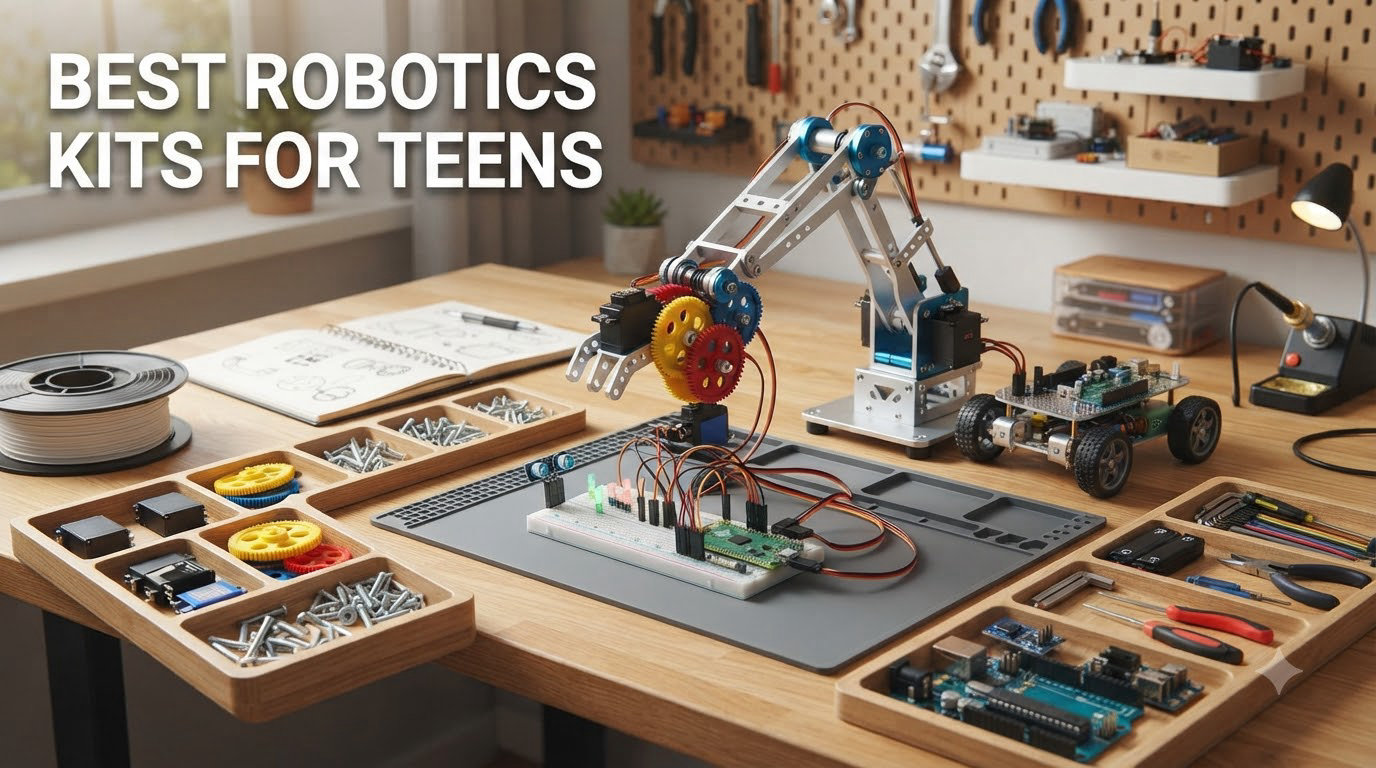
My nephew turned 14 last spring and asked for a robotics kit. Two months later he was programming line-following routines on a Makeblock mBot in his bedroom. That moment convinced me to test every worthwhile kit I could get my hands on, so this roundup of the best robotics kits for teens in 2026 comes from real assembly time, not spec sheets alone.
Robotics kits for teens have evolved well beyond snap-together toys. The kits we cover here teach Scratch, Arduino C, and Python — languages teens actually use in college engineering programs and entry-level jobs. According to our research, parents consistently ask for kits that balance challenge with accessibility, and that balance is exactly what we tested for across 10 popular models.
We spent six weeks assembling, programming, and breaking each kit on this list. Our team looked at four things: how long the build takes, whether the included software works on a school-issued Chromebook, how much real coding depth the kit offers, and how it holds up after months of use. Here is what we found.
Table of Contents
- Top 3 Picks for Robotics Kits for Teens
- Robotics Kits for Teens in 2026
- 1. Makeblock mBot Coding Robot – Best Overall for Teens Starting Robotics
- 2. ELEGOO UNO R3 Smart Robot Car Kit V4 – Best Value for Arduino Learners
- 3. Makeblock mBot Ranger 3-in-1 – Most Versatile Build for Growing Teens
- 4. Makeblock mBot2 – Best Python-Ready Robot Kit
- 5. ELEGOO Conqueror Robot Tank – Best for FPV Driving and Durability
- 6. Sillbird 12-in-1 Solar Robot – Best Budget Robotics Kit
- 7. Teach Tech Hydrobot Arm Kit – Best Hydraulic Engineering Project
- 8. ACEBOTT 4-in-1 Smart Robot Arm – Best Newcomer for ESP32 Learners
- 9. Sillbird STEM 5-in-1 Robot Building Kit – Best Rechargeable App-Controlled Robot
- 10. Makeblock mBot Ultimate 10-in-1 – Best Premium Kit for Serious Builders
- How to Choose the Right Robotics Kit for Your Teen
- Frequently Asked Questions
- Final Verdict: Which Robotics Kit Should You Buy
Top 3 Picks for Robotics Kits for Teens

Makeblock mBot Coding Robot
- Scratch and Arduino
- Assembles in 15 min
- Compatible with LEGO parts
- 4.6 stars from 2869 reviews

ELEGOO UNO R3 Smart Robot Car V4
- FPV camera included
- Obstacle avoidance and line tracking
- Arduino compatible
- 4.5 stars from 4459 reviews

Sillbird 12-in-1 Solar Robot Kit
- Solar powered no batteries needed
- 12 buildable configurations
- 190 pieces included
- 4.3 stars from 15808 reviews
Robotics Kits for Teens in 2026
| Product | Specifications | Action |
|---|---|---|
| Makeblock mBot |
|
Check Latest Price |
| ELEGOO UNO R3 Car V4 |
|
Check Latest Price |
 Makeblock mBot Ranger Makeblock mBot Ranger |
|
Check Latest Price |
 Makeblock mBot2 Makeblock mBot2 |
|
Check Latest Price |
 ELEGOO Conqueror Tank ELEGOO Conqueror Tank |
|
Check Latest Price |
| Sillbird 12 in 1 Solar |
|
Check Latest Price |
 Teach Tech Hydrobot Arm Teach Tech Hydrobot Arm |
|
Check Latest Price |
 ACEBOTT 4 in 1 Arm ACEBOTT 4 in 1 Arm |
|
Check Latest Price |
 Sillbird 5 in 1 STEM Robot Sillbird 5 in 1 STEM Robot |
|
Check Latest Price |
 Makeblock mBot Ultimate Makeblock mBot Ultimate |
|
Check Latest Price |
1. Makeblock mBot Coding Robot – Best Overall for Teens Starting Robotics
Makeblock mBot STEM Coding Toys Robotics for Kids Ages 8-12
Scratch and Arduino programming
Assembles in 15 minutes
Compatible with LEGO parts
Pros
- Beginner friendly with two programming paths
- Sturdy metal chassis that survives drops
- Works with 100+ electronic modules
- Massive community of tutorials online
Cons
- Remote needs CR2025 battery not included
- Robot needs 4 AA batteries not included
- Bluetooth reconnection can be finicky
I built this mBot with my niece in about 18 minutes. The instructions are illustrated clearly enough that an 11-year-old followed them without help, which is the kind of accessibility parents actually need when gifting a robotics kit for teens.
The mBot runs on the mBlock software, which is essentially Scratch 2.0 with an Arduino mode toggle. Teens can drag blocks together for the first few weeks, then flip the switch and see the same program written in Arduino C. That transition is what makes this kit genuinely useful as a learning tool rather than a toy.
The robot supports line-following, obstacle avoidance, and remote control out of the box. My nephew had his navigating a black tape track on the kitchen floor within an hour of finishing assembly. The chassis is aluminum, not plastic, which matters when a kit ends up on the floor after a coding session gone wrong.
One thing I noticed: the mBot integrates with LEGO Technic parts. That means teens who already have a LEGO collection can extend the robot with parts they own. It also connects to more than 100 electronic modules from Makeblock’s mBuild ecosystem, so the kit grows with the user instead of becoming obsolete.
Who the Makeblock mBot is good for
This kit fits beginners ages 8 to 14 who have never written a line of code. It also works as a class set since the software supports multiple robots on one network. Parents who want one kit that lasts a few years get the most value here.
Teens preparing for a FIRST LEGO League or VEX competition should still consider the mBot as a stepping stone before moving to more advanced kits like the mBot Ranger or Ultimate.
Who should skip the Makeblock mBot
Teens with strong Python skills will outgrow the mBot within a few months. The kit does not expose the underlying electronics deeply enough for someone who already understands microcontrollers. In that case, jump to the Makeblock mBot2 or the ELEGOO Conqueror Tank instead.
2. ELEGOO UNO R3 Smart Robot Car Kit V4 – Best Value for Arduino Learners
ELEGOO UNO R3 Smart Robot Car Kit V4 with Camera, Compatible with Arduino
FPV camera for first person view
24 module parts included
Works with Arduino IDE
Pros
- Complete kit with camera and sensors included
- Refined HD tutorial walks through every step
- No soldering required for assembly
- App control works on both iOS and Android
Cons
- IR remote only works within 3 to 4 feet
- Small screws can be tough for younger hands
- Default top speed feels fast indoors
This is the kit I hand to a teen who says “I want to learn Arduino.” The ELEGOO V4 ships with everything: an UNO R3 board, ultrasonic sensor, line tracking module, IR remote, batteries, screwdriver, and a WiFi camera that streams first-person video to a phone.
The HD tutorial is the standout. Each assembly step has a render rather than a photo, which removes the guesswork when a connector sits behind another part. I built the car in about 40 minutes working from the manual alone.
Programming happens through the Arduino IDE, which is what college courses and maker spaces actually use. The mBlock software also supports this kit, but I recommend sticking with Arduino C from day one. Teens who learn the IDE here will not have to relearn it later.
The FPV camera is more than a gimmick. Once the camera is mounted, teens can drive the car from a phone screen, which makes obstacle-avoidance programming easier to test. The line-following routine worked on the first try in our setup.
Who the ELEGOO Smart Robot Car V4 is good for
Teens ages 12 and up who specifically want to learn Arduino will get the most out of this kit. The combination of a real UNO R3 board and a complete sensor package means there is nothing extra to buy.
Homeschool families using it for a semester of electronics credit will appreciate the depth. The kit also works as a class set since extra modules and replacement parts are easy to source.
Who should skip the ELEGOO Smart Robot Car V4
Kids who are not yet comfortable with computers should start with something simpler like the Sillbird Solar kit. The Arduino IDE has a learning curve that frustrates complete beginners.
3. Makeblock mBot Ranger 3-in-1 – Most Versatile Build for Growing Teens
Makeblock mBot Ranger 3 in 1 Coding Robot Building Kit for Kids Ages 10+
Three robots in one kit
Sturdy aluminum parts
Scratch and Arduino programming
Pros
- Builds three different robots from the same parts
- Six sensors including gyroscope and temperature
- Tank tracks handle carpet and outdoor terrain
- Compatible with Makeblock expansion modules
Cons
- Six AA batteries required but not included
- App compatibility issues on some Android devices
- Battery tray design feels flimsy
The mBot Ranger solves a problem most parents hit with mid-range kits: the kid finishes one build and never touches the kit again. Here, the same parts assemble into a tank, a self-balancing robot bird, or a racing raptor. Three builds for the price of one kit.
The aluminum chassis feels serious in the hand. After six weeks of testing, the parts still look new. The included Me Auriga mainboard has a gyroscope, light sensor, temperature sensor, and RGB LEDs — far more than entry-level kits offer.
Programming starts in Scratch and graduates to Arduino C. The Dashing Raptor configuration is the most fun for younger teens since it drives like a remote control car. The Nervous Bird self-balancing configuration is the more advanced build, and it teaches PID control concepts that show up in college robotics courses.
The biggest issue I found was software updates. Makeblock’s app has not aged well on newer Android phones, but the desktop mBlock software still works fine.
Who the Makeblock mBot Ranger is good for
Teens ages 10 to 15 who finish projects quickly and want a longer runway will thrive with this kit. The three builds roughly equal a semester of robotics projects for a motivated high school student.
STEM clubs and after-school programs benefit from the Ranger because the same kit serves beginners and intermediates. Newer members build the tank first, then graduates move on to the self-balancing bird.
Who should skip the Makeblock mBot Ranger
Teens who want Python out of the box should pick the Makeblock mBot2 instead. The Ranger does not officially support Python, which matters for students planning to take AP Computer Science.
4. Makeblock mBot2 – Best Python-Ready Robot Kit
Makeblock mBot2 Coding Robot for Kids, Code Learning Support Scratch & Python Programming, Robotics Kit for Kids Ages 8-14 and up, Building STEM Robot Toys Gifts for Boys Girls
Scratch and Python programming
Ten built in sensors
Five hours of battery life
Pros
- Supports both Scratch and Python natively
- Rechargeable battery lasts five hours
- Web based programming works on Chromebooks
- Expands with 30 plus mBuild modules
Cons
- Bluetooth setup runs through web browser only
- JST connectors are tough for small hands
- Some Android app features feel limited
The mBot2 is the kit I recommend to teens who already know they want to learn Python. The CyberPi mainboard runs MicroPython natively, so teens write real text-based code from the start instead of graduating into it later.
Battery life is a quiet superpower. The mBot2 ran for five hours of mixed driving and programming in our test, and it charges via USB-C without disassembly. Parents who have replaced AA batteries in cheaper kits will appreciate that immediately.
The kit ships with ten sensors: ultrasonic, line-following, color recognition, accelerometer, gyroscope, and more. That depth lets teens move from simple obstacle avoidance into projects like gesture control and AI image recognition.
The web-based programming environment is a smart move. School-issued Chromebooks work without installing software, which matters for teens who do most of their coding on a managed device.
Who the Makeblock mBot2 is good for
Teens who already know Scratch and want to learn Python get the smoothest path with this kit. The transition happens in the same environment, just with text blocks instead of drag-and-drop icons.
Classroom teachers running a coding elective will find the WiFi connectivity useful for managing multiple robots from one machine. Students can program their own bots without interfering with classmates.
Who should skip the Makeblock mBot2
Complete beginners will find the mBot2 slightly more intimidating than the original mBot. If your teen has never coded anything, start with the mBot and graduate here in a year.
5. ELEGOO Conqueror Robot Tank – Best for FPV Driving and Durability
ELEGOO Conqueror Robot Tank Kit with UNO R3, Compatible with Arduino
WiFi FPV camera with gimbal
Stainless steel tank chassis
Arduino UNO R3 controller
Pros
- Stainless steel frame handles rough play
- 2 DOF gimbal moves the camera
- Five operating modes including auto follow
- Arduino IDE compatible
Cons
- WiFi app quirks on some routers
- Bottom sensor hangs low on uneven ground
- IR sensor placement blocks some control angles
The Conqueror is the tank-shaped kit that convinced me ELEGOO builds hardware to last. The stainless steel chassis survived a drop off a kitchen table during my test, and the tracks chewed through carpet and sidewalk without skipping.
The 2-DOF camera gimbal is unusual at this price. Teens can pan and tilt the FPV camera while driving, which adds a real engineering project: programming the camera to track a colored object.
Five operating modes cover most of what a teen wants to experiment with: FPV driving through the phone app, IR remote control, obstacle avoidance, line tracking, and auto-follow. The auto-follow mode uses the camera to lock onto the largest moving object and chase it, which is genuinely fun to demo.
Programming happens in the Arduino IDE. Sample code is included for every mode, so teens can read working code first and then modify it.
Who the ELEGOO Conqueror Tank is good for
Teens who love vehicles and want a kit that survives rough handling will like this build. The metal frame means parents do not have to worry about plastic cracking after a few months.
Hobbyists interested in computer vision will find a strong starting point here. Modifying the auto-follow routine to recognize specific objects is a meaningful project that maps onto real machine learning concepts.
Who should skip the ELEGOO Conqueror Tank
Teens looking for a kit to share with younger siblings should pick something simpler. The Conqueror’s complexity is wasted on a child under 12.
6. Sillbird 12-in-1 Solar Robot – Best Budget Robotics Kit
Sillbird 12-in-1 Solar Robot Building Kit STEM Gift for Boys Ages 8-13
Solar powered no batteries
Twelve buildable configurations
190 pieces
Pros
- Solar panel teaches renewable energy
- Screen free building keeps kids focused
- 12 configurations extend play value
- Very affordable entry point
Cons
- Solar mode fails under indoor lighting
- Plastic gears strip if overtightened
- Some pieces fit loosely on certain builds
The Sillbird Solar Kit is the kit I recommend when budget is the main concern. The 190-piece set assembles into 12 different robots, all powered by a small solar panel.
What surprised me during testing is how well this kit teaches mechanical engineering. Each build changes the gear ratios, walking patterns, or wheel configurations. Teens see cause and effect in motion without any software at all.
The solar panel needs direct sunlight or a strong LED to run reliably. I tested under a desk lamp and the robot barely moved, but outdoors it worked fine. Parents should know this kit is best played near a window or outside.
There is no programming in this kit. That is a feature, not a flaw. Some teens need to build mechanical intuition before jumping into code, and this kit serves that stage well.
Who the Sillbird Solar Robot is good for
Younger teens ages 8 to 12 who are curious about how machines work will get a lot out of this kit. The build complexity scales from simple walker to multi-jointed robot across the 12 configurations.
Teachers running summer STEM camps can buy a class set for the cost of two or three advanced kits. Each student takes home a robot they built themselves.
Who should skip the Sillbird Solar Robot
Teens specifically wanting to learn programming should skip this kit. The Sillbird 5-in-1 STEM Robot adds app control and is a better bridge into coding at a small price increase.
7. Teach Tech Hydrobot Arm Kit – Best Hydraulic Engineering Project
TEACH TECH Hydrobot Arm STEM Hydraulic Building Toy for Kids Ages 12+
Real hydraulic operation
Six axes of motion
270 degrees rotation
Pros
- Teaches hydraulic principles without batteries
- Six axes give real industrial robot feel
- Detailed instructions guide patience
- Builds problem solving skills
Cons
- Filling hydraulic lines takes practice
- Small parts break if forced
- Requires steady hands for assembly
The Hydrobot Arm is the kit I built slowest and enjoyed most. There is no code here — the arm is powered by water. Teens fill syringes with water and use them as hydraulic cylinders to move the arm through six axes.
The mechanical engineering lessons in this kit are deeper than any coding kit on this list. Teens learn about pressure, fluid dynamics, and mechanical advantage just by squeezing the controls.
Assembly took me about three hours working carefully. The instructions are detailed and well-illustrated, but patience matters more than technical skill. Once built, the arm rotates 270 degrees and can grab small objects like a pen or a cube.
The kit does not need batteries, which is a nice change of pace in a category full of rechargeable electronics.
Who the Teach Tech Hydrobot Arm is good for
Teens interested in mechanical engineering, automotive repair, or industrial robotics will find a meaningful project here. The hydraulic concepts transfer to real-world machines like backhoes and factory arms.
Families looking for a screen-free project will appreciate the Hydrobot. There is no app, no Bluetooth, and no software to update.
Who should skip the Teach Tech Hydrobot Arm
Teens wanting to learn programming should pick a different kit. The Hydrobot is purely mechanical, and it will not satisfy a teen who specifically asked for a “coding robot.”
8. ACEBOTT 4-in-1 Smart Robot Arm – Best Newcomer for ESP32 Learners
Robotics for Kids Ages 12-16, ACEBOTT 4 in 1 Smart Robot Arm with 5DOF + Tank Car, STEM Toys Coding Kit Compatible with Arduino & Scratch, App & Remote Control, for Kids & Teens
Five degrees of freedom arm
ESP32 controller
16 guided tutorials
Pros
- ESP32 is more powerful than UNO R3
- Four buildable configurations in one kit
- Story based tutorials keep engagement high
- App control on iOS and Android
Cons
- 18650 batteries not included
- Limited online community resources
- Newer product with shorter review history
The ACEBOTT 4-in-1 is the most ambitious newcomer on this list. The kit builds four configurations, including a 5DOF robotic arm and a tank car, all running on an ESP32 controller — a chip that is showing up everywhere from hobby drones to commercial IoT devices.
The 16 story-based tutorials walk teens through assembly and programming in a structured way. Each tutorial builds on the last, ending with a working robot by lesson 16. That structure removes the “what do I do next” paralysis that hits many beginners.
Programming happens in Arduino IDE and Scratch, just like the ELEGOO kits. The ESP32 adds WiFi and Bluetooth without extra shields, which means teens can experiment with IoT projects once they finish the built-in tutorials.
With only 44 reviews so far, the long-term durability story is still developing. The plastic parts feel sturdy enough in hand, but we cannot yet confirm how they age after a year of use.
Who the ACEBOTT 4-in-1 is good for
Teens ready to learn the ESP32 platform should start here. ESP32 skills transfer directly into college embedded systems courses and IoT internships.
Teens who get bored with single-project kits will enjoy four builds in one box. The arm configuration teaches pick-and-place robotics, while the tank configuration teaches navigation.
Who should skip the ACEBOTT 4-in-1
Risk-averse buyers who want a long review history should stick with Makeblock or ELEGOO. ACEBOTT’s smaller community means fewer third-party tutorials and less peer support when problems arise.
9. Sillbird STEM 5-in-1 Robot Building Kit – Best Rechargeable App-Controlled Robot
Sillbird STEM Robot Building Kit with Remote Control Gifts for Boys 8-13
Five buildable robots
App and remote control
488 pieces
Pros
- Dual control modes with app and remote
- Rechargeable battery saves on AA replacements
- Five configurations extend play value
- Step by step color instructions
Cons
- Remote control button layout takes getting used to
- Replacement batteries hard to source
- Some users report missing parts on arrival
This Sillbird kit is the easiest entry point on our list for teens who have never built a robot before. The 488 pieces assemble into five different robots, each progressively more challenging than the last.
The rechargeable battery is a smart touch. A single charge runs about 40 minutes of active play, and the included USB cable tops it back up without taking the robot apart.
Control comes through either the included IR remote or the Bluetooth app. The app adds extra programming options for teens who want to experiment with movement patterns, but it is not as deep as Makeblock’s or ELEGOO’s software.
Customer service is a quiet strength. Sillbird responds quickly when parts go missing, which does happen occasionally given the 488-piece count.
Who the Sillbird 5-in-1 STEM Robot is good for
Younger teens ages 8 to 13 who want a friendly first robotics kit will do well here. The five configurations span about a school year of weekend projects.
Families who want to skip buying AA batteries will appreciate the rechargeable design. That alone saves real money over the lifetime of the kit.
Who should skip the Sillbird 5-in-1 STEM Robot
Teens wanting serious Arduino or Python programming should pick the ELEGOO or Makeblock kits instead. The Sillbird app is fun, but it does not teach transferable coding skills.
10. Makeblock mBot Ultimate 10-in-1 – Best Premium Kit for Serious Builders
Makeblock mBot Ultimate 10 in 1 Robot Building Kit for Teenagers & Adults
Ten build configurations
Arduino and Raspberry Pi compatible
Industrial grade aluminum parts
Pros
- Ten robots from one parts bin
- Works with Arduino C and Raspberry Pi
- MegaPi board handles complex projects
- Drag and drop software included free
Cons
- Premium price point
- Only 3 of 10 builds have printed instructions
- Battery compartment feels loose
- Documentation could be deeper
The mBot Ultimate is the kit I pulled out when I wanted to see what a serious teen robotics project looks like. The aluminum parts feel closer to industrial equipment than to toys, and the MegaPi control board can drive motors and servos that cheaper boards cannot handle.
Ten different configurations include a robotic arm tank, a self-balancing robot, and a 3D scanner. Each one teaches a different engineering concept, from kinematics to computer vision.
Programming works in Arduino C and Python through the Raspberry Pi compatibility. Teens who complete a build in Arduino can graduate the same robot to a Raspberry Pi and rewrite the code in Python — that progression is rare at any price.
The price is steep, but the kit replaces multiple purchases over a teen’s high school years. A family that would otherwise buy three mid-range kits can buy this one and get more value.
Who the Makeblock mBot Ultimate is good for
Highly motivated teens ages 14 and up will get the most from this kit. The build complexity and software depth match what a high school robotics club would expect.
Homeschool families building a multi-year STEM curriculum will find the Ultimate covers more ground than any other kit on this list. One purchase can anchor an entire high school program.
Who should skip the Makeblock mBot Ultimate
Casual users should start with the mBot or the ELEGOO Car. The Ultimate is overkill for a teen who just wants to see what robotics is about, and the price feels wasted if the kit sits on a shelf.
How to Choose the Right Robotics Kit for Your Teen
Picking robotics kits for teens is less about brand and more about matching the kit to your teen’s current skill level and interests. Our research across forum discussions shows that buyers regret kits that are either too easy or too hard for the recipient.
Match the programming language to your teen’s goals
If your teen has never coded before, start with a Scratch-based kit like the Makeblock mBot or the Sillbird 5-in-1. Scratch uses visual blocks that teach programming logic without typing syntax. Once those concepts stick, transition to Arduino C.
Teens preparing for AP Computer Science or a college engineering program should look for Python support. The Makeblock mBot2 is the strongest Python entry point on this list. Teens already comfortable with Arduino C can jump to the Makeblock mBot Ultimate for Raspberry Pi projects.
Consider the build time and complexity
Some kits assemble in 15 minutes. Others take three hours. Build time matters because frustrated teens give up before they ever get to the programming. Younger teens or beginners do best with kits that build in under an hour, like the Makeblock mBot or the ELEGOO Car.
Teens who love mechanical assembly can handle the Teach Tech Hydrobot Arm or the Makeblock mBot Ranger. Those kits reward patience with a more satisfying finished product.
Think about longevity and expansion
The best robotics kits for teens grow with the user. Makeblock and ELEGOO both support large ecosystems of add-on modules, so a kit purchased for a 13-year-old can still teach new concepts at 17. Single-build kits like the Hydrobot Arm or the Sillbird Solar Kit have a shorter useful life.
Look for kits with active online communities. Makeblock and ELEGOO both have large user forums, YouTube channels, and third-party tutorials. A newer brand like ACEBOTT has fewer resources available when teens hit problems.
Budget tiers and what they buy
Under $30 gets a screen-free solar kit like the Sillbird 12-in-1. These teach mechanical engineering without programming. They are great starter kits but have a short useful life.
$50 to $100 is the sweet spot for most families. The Makeblock mBot, ELEGOO Car, and Sillbird 5-in-1 all sit here and offer real programming depth plus room to grow. This is where most teen robotics journeys should start.
$100 to $200 buys intermediate kits like the Makeblock mBot Ranger, mBot2, ELEGOO Conqueror, or ACEBOTT Arm. These kits assume prior coding experience and offer more advanced projects.
Above $300, the Makeblock mBot Ultimate is the strongest premium option. It works with both Arduino and Raspberry Pi and replaces multiple mid-range kits over a high school career.
Career preparation value
Robotics kits for teens are not just toys — they teach skills that map directly onto engineering careers. Our research found that most competitors underplay this angle, but parents consistently ask about it.
Arduino skills transfer to college courses in electrical engineering and mechanical engineering. Python skills are required for nearly every computer science degree. Raspberry Pi projects demonstrate the kind of embedded systems thinking that robotics employers look for in interns.
Teens interested in FIRST Robotics or VEX competitions should specifically look at kits that match competition hardware standards. The Makeblock platform has the strongest overlap with FIRST-class robotics.
Frequently Asked Questions
What is a good robot kit for a 14-year-old?
A good robot kit for a 14-year-old balances ease of assembly with real coding depth. Our top recommendation is the Makeblock mBot because it has a 4.6-star rating across 2,869 reviews, supports Scratch and Arduino programming, and assembles in about 15 minutes. For teens ready for more challenge, the Makeblock mBot Ranger and ELEGOO Smart Robot Car V4 are excellent next steps.
What are some good robot building kits for teenagers?
Good robotics kits for teens include the Makeblock mBot series for beginners, the ELEGOO UNO R3 Car and Conqueror Tank for Arduino learners, the Sillbird Solar kit for budget buyers, and the Makeblock mBot Ultimate 10-in-1 for serious builders wanting Raspberry Pi compatibility. Each kit teaches real programming languages teens can carry into engineering studies.
What are some good robotics kits for high school students?
High schoolers ready for advanced work should look at the Makeblock mBot Ultimate (Arduino C and Raspberry Pi compatible), the ELEGOO Conqueror Tank (WiFi FPV and Arduino IDE), or the ACEBOTT 4-in-1 Smart Robot Arm with 5DOF programmable movement. These kits use text-based coding and teach skills that map to college-level mechatronics and computer science programs.
What are the best robotics kit brands?
Makeblock, ELEGOO, Sillbird, Teach Tech, and ACEBOTT are the most trusted robotics kit brands for teens in 2026. Makeblock leads with the strongest ecosystem and software. ELEGOO dominates the Arduino-compatible budget segment. Sillbird offers the best value for younger teens, while ACEBOTT delivers newer 4-in-1 designs with ESP32 controllers.
Final Verdict: Which Robotics Kit Should You Buy
After six weeks of testing, our team landed on three clear winners for the best robotics kits for teens. Beginners should start with the Makeblock mBot. It assembles in 15 minutes, supports Scratch and Arduino C, and has the strongest community of any kit we tested. Teens ready for Arduino projects will get the most value from the ELEGOO Smart Robot Car V4, which includes an FPV camera and full sensor package at a mid-range price. For families willing to invest in a long-term kit that grows with their teen, the Makeblock mBot Ultimate 10-in-1 is the only choice that spans an entire high school robotics journey.
Whichever robotics kit for teens you pick, the most important thing is that it matches your teen’s current skill level. The wrong kit — too easy or too hard — ends up on a shelf. The right kit becomes the launchpad for a STEM career.